
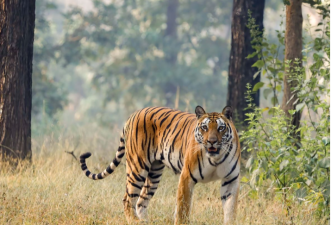
India had 52 tiger reserves in the period 2011-2021, and the India State of Forests Report 2021 recorded a net decrease of 22.62 sq km in forest cover across these reserves. A Nature study published in May 2023 analysed 45 tiger reserves and found that 11 reserves avoided deforestation, while 4 reserves in the North-East recorded higher-than-expected forest loss.
Tiger Reserve Coverage In India
Tiger reserves are notified under the Wildlife (Protection) Act, 1972, and they form the core of India’s tiger conservation landscape. The National Tiger Conservation Authority manages tiger conservation measures under Project Tiger, which was launched in 1973.
Forest Cover Trends In Reserves
- The ISFR 2021 recorded forest cover decline in 32 of 52 tiger reserves between 2011 and 2021.
- Kawal Tiger Reserve in Telangana recorded the largest decline of 118.97 sq km during the decade.
- Bhadra Tiger Reserve in Karnataka recorded a decline of 53.09 sq km during the decade.
- Sunderbans Tiger Reserve in West Bengal recorded a decline of 40 sq km during the decade.
- Buxa Tiger Reserve in West Bengal recorded the largest increase of 238.80 sq km during the decade.
Remote Sensing And Forest Assessment
Landsat 5 TM is a satellite sensor used for long-term land cover analysis and vegetation monitoring. Studies using Landsat data have assessed vegetation browning and drying in 25 Indian tiger reserves, with about half of the reserves showing extensive vegetation stress.
Carbon Accounting In Protected Areas
Between 2007 and 2020, enhanced protection in Indian tiger reserves was associated with avoided forest loss of over 5,802 hectares. The same period corresponded to about 1.08 million metric tons of carbon dioxide equivalent emissions.
Protected Area Context
India has a network of tiger reserves spread across multiple forest types, including tropical moist forests, dry deciduous forests, mangroves, and North-Eastern hill forests. Forest cover change in these reserves is measured through satellite imagery, field verification, and periodic forest assessments.
Last Modified: April 25, 2026