
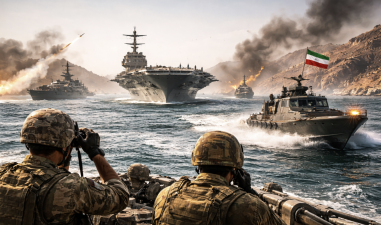
Naval forces from Iran, Russia, and China are set to conduct the Maritime Security Belt 2026 exercise in waters around the Strait of Hormuz, even as the United States expands its military deployment in the Gulf. The timing is significant: indirect talks over Iran’s nuclear programme continue amid heightened strategic mistrust and sustained sanctions pressure. The convergence of joint drills and parallel force mobilisations has sharpened global attention on one of the world’s most sensitive maritime chokepoints.
What Is Maritime Security Belt 2026?
4
The Maritime Security Belt series is a trilateral naval exercise hosted by Iran, involving Russia and China. The 2026 edition will focus on:
- Coordinated manoeuvres by surface combatants and support vessels.
- Naval aviation drills.
- Anti-piracy and search-and-rescue operations.
- Simulated escort missions for commercial shipping.
- Communication and interoperability exercises.
According to Russian officials, the stated objective is to enhance coordination in securing maritime trade routes that are increasingly vulnerable to disruption.
The exercise underscores growing military cooperation between Tehran, Moscow, and Beijing, particularly in the maritime domain.
The Strategic Significance of the Strait of Hormuz
4
The Strait of Hormuz is among the world’s most critical energy arteries. Roughly 17–20 million barrels of oil transit the strait daily, representing nearly one-fifth of global oil consumption. Significant quantities of liquefied natural gas (LNG), particularly from Qatar, also pass through the narrow channel.
Any disruption in Hormuz would have immediate implications for:
- Global oil prices.
- Energy security of major importers, including India, China, and Europe.
- Shipping insurance costs and maritime risk premiums.
Given its geography — a narrow waterway between Iran and Oman — the strait has long been vulnerable to blockades, missile threats, and naval confrontations.
Expanded U.S. Military Deployment in the Gulf
4
Parallel to the trilateral exercise, the United States has reinforced its presence under the United States Central Command (CENTCOM).
Notably:
- The USS Abraham Lincoln and USS Gerald R. Ford carrier strike groups have been deployed to the region.
- Arleigh Burke-class destroyers and littoral combat ships are operating in and around the Persian Gulf.
- Air assets remain stationed at regional bases in Qatar, Jordan, and other Gulf partner states.
The deployment signals deterrence, aimed at reassuring regional allies and countering potential escalation.
Nuclear Tensions and the Shadow of Operation Midnight Hammer
Tensions between Washington and Tehran remain rooted in disputes over Iran’s uranium enrichment activities and missile development. The United States seeks stricter limits, while Iran maintains its programme is civilian and demands sanctions relief.
The current phase follows last year’s U.S. strikes on nuclear facilities such as Fordow and Natanz during Operation Midnight Hammer. The operation reportedly involved B-2 Spirit stealth bombers using GBU-57 Massive Ordnance Penetrator bombs, supported by Tomahawk missile strikes.
The aftermath included missile and drone exchanges across the region, pushing tensions to the brink. Though indirect negotiations continue through regional intermediaries, both sides maintain substantial military deployments.
Emerging Strategic Alignments
The joint naval exercise reflects broader geopolitical shifts:
- Deepening security cooperation between Iran, Russia, and China.
- Challenge to U.S.-led maritime dominance in the Gulf.
- Symbolic assertion of multipolar naval presence in critical waterways.
For Russia and China, participation signals political solidarity with Iran amid Western sanctions and strategic competition.
Implications for Global Energy and India
For energy-importing nations like India, stability in Hormuz is vital. Any prolonged disruption could:
- Trigger oil price spikes and inflationary pressures.
- Disrupt LNG supplies.
- Increase freight and insurance costs.
India’s policy approach typically balances relations with the United States, Gulf states, and Iran, while emphasising freedom of navigation and maritime security.
What to Note for Prelims?
- Maritime Security Belt – joint naval exercise of Iran, Russia, and China.
- Strait of Hormuz – key global oil chokepoint.
- United States Central Command (CENTCOM) – oversees U.S. operations in the Middle East.
- GBU-57 Massive Ordnance Penetrator – bunker-busting bomb.
- Carrier strike group – centred on aircraft carriers like USS Abraham Lincoln.
What to Note for Mains?
- Energy security and geopolitical chokepoints.
- U.S.–Iran relations and nuclear diplomacy.
- Emerging multipolar naval alignments.
- Impact of Gulf tensions on global markets.
- Balancing diplomacy and deterrence in West Asia.