
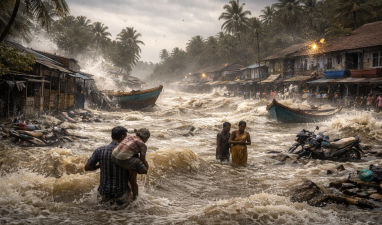
In a first-of-its-kind move, Kerala has declared flooding caused by tidal rise along its coastline as a “State-specific disaster.” The decision enables affected communities to receive financial assistance under norms similar to the State Disaster Response Fund (SDRF). The announcement reflects the growing vulnerability of Kerala’s low-lying coastal regions, where routine high tides are increasingly translating into year-round flooding and livelihood disruption.
What Exactly Is Tidal Flooding Along Kerala’s Coast?
4
Tidal flooding occurs when the Arabian Sea level temporarily rises above a defined threshold, inundating low-lying coastal areas. Unlike cyclone-driven storm surges, this phenomenon:
- Occurs twice daily with regular tidal cycles.
- Becomes more severe during full moon and new moon phases (spring tides).
- Intensifies when coastal storms coincide with high tides.
In districts such as Ernakulam, Alappuzha, and parts of Kochi, seawater often enters residential areas through rivers, canals, and backwaters. Areas like Vypin, Chellanam, Edakochi, and Kumbalanghi experience repeated seawater ingress.
Why Declare a ‘Routine’ Event a Disaster?
Under the Disaster Management Act, 2005, disasters typically include sudden or extreme events. Routine tidal rise does not automatically qualify for assistance under the SDRF.
However, Section 2(d) of the Act defines a disaster as a natural or man-made event that results in substantial loss of life, livelihood, or property. Kerala has argued that when high tides cross the High Tide Line (HTL) and cause recurring damage, the phenomenon exceeds normal environmental variation and meets the legal threshold of a disaster.
This interpretation allows financial relief to affected families even though the event is cyclical.
Kerala’s Unique Coastal Vulnerability
4
Kerala’s geography makes it particularly vulnerable:
- Parts of Kuttanad in Alappuzha lie below sea level.
- Kochi city is barely above mean sea level.
- Dense settlement patterns exist along rivers and backwaters.
- Heavy siltation has reduced the carrying capacity of rivers and lakes.
When seawater breaches the HTL, it floods habitations built in floodplains and puramboke lands. Around 10% of Kerala’s population is estimated to be affected by high-tide flooding, making it a structural risk rather than an episodic hazard.
How Is It Different from Rainfall Flooding?
Rainfall-induced floods are seasonal and often linked to extreme monsoon events. Tidal flooding, however:
- Can occur throughout the year.
- Is driven by astronomical cycles.
- Is worsened by climate change-induced sea level rise.
- Can combine with storms to create compound flooding events.
This year-round hazard exposure has strengthened the State’s argument that tidal flooding requires a separate disaster classification.
Impact on Coastal Communities and Economy
The damage extends beyond homes:
- Fisherfolk lose fishing days and gear.
- Coastal agriculture faces saline intrusion.
- Infrastructure such as roads and drainage systems deteriorate.
- Small traders and daily wage earners suffer income loss.
Repeated saline water intrusion also degrades soil fertility and freshwater sources, compounding long-term ecological stress.
Other State-Specific Disasters Notified by Kerala
Kerala has previously declared several State-specific disasters in addition to nationally notified categories. These include:
- Coastal erosion.
- Lightning.
- Strong winds.
- Soil piping.
- Heatwave and sunstroke.
- Human-wildlife conflict.
Recently, the State also declared the wreckage of the cargo vessel MSE Elsa 3 — which capsized off the Kerala coast — a State-specific disaster due to environmental and economic risks.
Broader Policy Significance
Kerala’s move sets a precedent in disaster governance. It signals:
- Recognition of slow-onset and recurring hazards.
- Adaptive interpretation of disaster law in climate-vulnerable regions.
- Need to revisit SDRF norms in the era of sea level rise.
- Growing importance of coastal resilience planning.
With climate change intensifying coastal risks, other coastal States may consider similar classifications in the future.
What to Note for Prelims?
- Tidal flooding – caused by periodic sea level rise exceeding HTL.
- Kerala: First State to declare tidal flooding a State-specific disaster.
- Section 2(d) of Disaster Management Act, 2005 – definition of disaster.
- Spring tides – occur during full and new moon phases.
- Vulnerable regions – Kuttanad (below sea level), Kochi coast.
What to Note for Mains?
- Climate change and coastal vulnerability in India.
- Reinterpreting disaster governance frameworks.
- Compound flooding and urban coastal planning.
- Balancing routine natural phenomena and disaster relief norms.
- Need for integrated coastal zone management.