
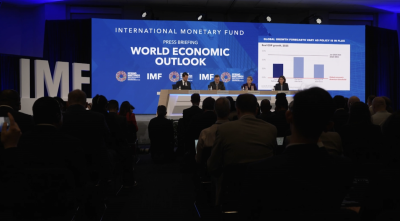
The International Monetary Fund (IMF) released its latest World Economic Outlook, revising global growth projections downward due to rising inflation and geopolitical tensions. The IMF forecasted global GDP growth at 3.0% for 2024, down from the previous estimate of 3.4%. The revision reflects slower expansion in major economies including the United States, Eurozone, and China.
Global Growth Projections
The IMF projected 3.0% global growth in 2024 and 3.1% in 2025. The United States is expected to grow at 2.1% in 2024, a reduction from 2.5%. The Eurozone’s growth forecast was cut to 1.2% from 1.5%. China’s growth is projected at 4.5%, down from 5.0%. Emerging markets and developing economies are expected to grow at 4.3%, a slight downward revision.
Inflation and Monetary Policy
Persistent inflation remains a key challenge, with global inflation forecasted at 5.6% in 2024. Central banks are expected to maintain tight monetary policies to control inflation, with interest rates remaining elevated in advanced economies. The IMF noted risks of policy missteps that could trigger sharper slowdowns.
Geopolitical and Supply Chain Risks
Geopolitical tensions, including the Russia-Ukraine conflict, continue to disrupt energy and food supplies. Supply chain bottlenecks are easing but remain a concern in some regions. Rising commodity prices have contributed to inflationary pressures globally.
Risks and Uncertainties
The IMF highlighted risks including potential financial market volatility, debt vulnerabilities in emerging markets, and uneven vaccine access affecting recovery. Climate-related shocks and the pace of technological adoption also pose uncertainties to growth trajectories.
What to Study for UPSC Exams?
- Global Financial Institutions
- Monetary Policy Tools
- Geopolitics and Economic Impact
- Supply Chain Management
Global Financial Institutions
Global financial institutions include entities like the IMF, World Bank, and regional development banks. The IMF was established in 1944 to ensure global monetary cooperation and financial stability. The World Bank primarily focuses on long-term economic development and poverty reduction through loans and grants. These institutions influence exchange rates, provide emergency funding, and set international financial standards.
Monetary Policy Tools
Monetary policy tools include interest rate adjustments, open market operations, and reserve requirements. Central banks use these to control inflation and stabilize currency. Quantitative easing involves large-scale asset purchases to inject liquidity. Forward guidance communicates future policy intentions to influence market expectations and economic behavior.
Geopolitics and Economic Impact
Geopolitical events like wars, sanctions, and alliances reshape trade flows and energy markets. Conflicts can cause commodity price spikes and supply chain disruptions. Economic sanctions restrict financial transactions to influence state behavior. Geopolitical stability often correlates with investor confidence and capital flows.
Supply Chain Management
Supply chain management coordinates production, shipment, and distribution of goods. Just-in-time inventory reduces holding costs but increases vulnerability to disruptions. Digital technologies like blockchain enhance transparency and traceability. Global supply chains are sensitive to geopolitical risks, natural disasters, and pandemics.
Last Modified: April 15, 2026