
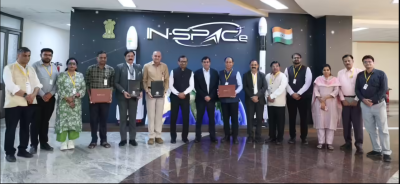
The Indian National Space Promotion and Authorization Centre signed two strategic Memoranda of Understanding with Gujarat-based educational institutions on 30 April 2026. The three-year agreements with Kaushalya – The Skill University, Ahmedabad, and the New Age Makers Institute of Technology, Gandhinagar, aim to construct a skilled workforce pipeline for the domestic commercial space market. This cooperative initiative focuses on curriculum development, academic outreach, internships, and industry-linked learning modules. These agreements operate alongside a central scheme aimed at building specialized space laboratories across Indian universities to provide students with technical exposure to satellite assemblies and rocket propulsion networks.
Institutional Framework of IN-SPACe
The Indian National Space Promotion and Authorization Centre functions as a single-window, autonomous nodal agency operating under the Department of Space.
Mandate and Regulatory Role
Established during the 2020 space sector reforms, the organization balances regulatory oversight with industry promotion:
- Permitting Authority: Evaluates and authorizes space activities by Non-Governmental Entities (NGEs), including the launch of vehicles, deployment of satellites, and operation of ground stations.
- Asset Sharing: Facilitates the shared use of Indian Space Research Organisation (ISRO) infrastructure, test facilities, and launch pads by private industry players.
- Technology Transfer: Oversees the systematic transfer of specialized space technologies from public institutions to private enterprises and startups.
- Capacity Building: Connects academia with commercial space enterprises to align educational training with industrial engineering standards.
Academic Partnerships and Skill Initiatives
The 2026 academic partnerships deploy targeted operational tools to bridge the gap between theoretical physics and industrial aerospace manufacturing.
Core Components of the MoUs
The cooperative framework outlines clear structural responsibilities split between the space promoter and the universities:
| Partnership Vector | Operational Deliverables | Target Audience |
| Curriculum Co-development | Integrating technical courses on satellite design, payload telemetry, and composite rocket materials into existing engineering degrees. | Undergraduate and Diploma Students |
| Hands-on Immersion | Organizing state-level hackathons, payload assembly simulations, and technical bootcamps. | Engineering Graduates and Research Scholars |
| Industrial Interfacing | Creating mandatory internship tracks with private launch-vehicle operators and satellite aggregators. | Skill University Trainees |
| Academic Outreach | Delivering technical seminars and design workshops led by veteran space scientists. | Faculty Members and Private Startups |
University Space Laboratories Scheme
To provide practical exposure, the Union government is driving the creation of on-campus space laboratories across selected national universities. These specialized units feature:
- Cleanroom environments for testing miniature components and CubeSats.
- Telemetry equipment to track real-time signals from operational student-built satellites.
- Simulation software to map orbital trajectories and evaluate launch stresses.
Industrial Base and Infrastructure Expansion in Gujarat
Gujarat is converting its industrial belts into clusters for precision aerospace engineering.
Sanand Space Manufacturing Cluster
The Government of Gujarat signed a foundational MoU with the space promoter to build a dedicated space manufacturing cluster at Khoraj in the Sanand industrial zone.
- Land Allocation: The Gujarat Industrial Development Corporation reserved an industrial land parcel spanning 100 acres inside the Khoraj estate.
- Support Mechanism: The space promoter provides direct financial incentives, technical guidance, and operational clearances, while the state government supplies basic physical infrastructure and logistical links.
- Private Integration: Sanand houses India’s first integrated private satellite manufacturing unit, named the Palmnaro facility, set up by Azista Space to produce complete satellite platforms and high-resolution electro-optical payloads under a single roof.
- Incubation Support: A central technical support and incubation center works directly out of the agency’s headquarters in Ahmedabad to guide early-stage aerospace startups.
IASPOINT Booster Facts for UPSC
- NGE Definition: Under the Indian Space Policy, Non-Governmental Entities include private companies, registered trusts, societies, academic institutions, and independent research bodies engaged in space operations.
- Indian Space Policy 2023: This document delineates the roles of distinct entities. ISRO transitions into a research and development body focusing on advanced frontier technologies; NewSpace India Limited handles commercial production and launches; and IN-SPACe acts as the omni-directional regulator for private ventures.
- FDI Limits in Space Sector: The Union Cabinet updated the Foreign Direct Investment policy for the space domain. Up to 74% FDI is allowed under the automatic route for satellite manufacturing, operations, and data products. Up to 49% is permitted automatically for launch vehicles and spaceports. Up to 100% is allowed under the automatic route for manufacturing satellite sub-components.
- The Sanand Industrial Ecosystem: Known historically as an automotive assembly hub, Sanand is designated a Japanese industrial township. Its expanding logistics network makes it an ideal testing ground for high-precision aerospace manufacturing.