
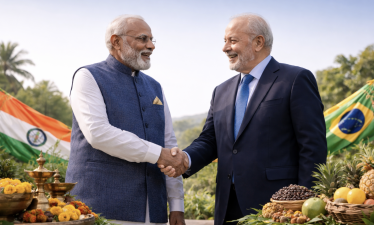
India and Brazil have deepened their cooperation in intellectual property protection with the signing of a Traditional Knowledge Digital Library (TKDL) Access Agreement. The pact between the [“National Institute of Industrial Property”,”brazil patent office”] (INPI), Brazil, and the [“Council of Scientific and Industrial Research”,”india research body”] (CSIR), India, allows Brazil’s patent office to access India’s pioneering prior-art database on traditional knowledge. The agreement was exchanged in the presence of [“Luiz Inácio Lula da Silva”,”brazil president”] and [“Narendra Modi”,”india prime minister”] during the Brazilian President’s State Visit to India in February 2026.
What the TKDL Access Agreement Provides
Under the arrangement, Brazil’s patent examiners will gain access to the TKDL database for use during patent examination and grant procedures. This will help assess novelty and prior art claims in applications that may involve traditional medicinal formulations or practices.
The agreement strengthens:
- Cooperation in traditional knowledge (TK) protection.
- Collaboration in intellectual property rights (IPR).
- Efforts to prevent biopiracy and misappropriation.
With Brazil’s inclusion, 18 patent offices worldwide now have access to the TKDL under Non-Disclosure Agreements.
What Is the Traditional Knowledge Digital Library?
The [“Traditional Knowledge Digital Library”,”india tk database”] (TKDL) was established in 2001 by the Government of India as a collaborative initiative between CSIR and the Ministry of AYUSH.
Its core objective is defensive protection — preventing the erroneous grant of patents based on India’s traditional knowledge systems.
The TKDL currently documents over 5.2 lakh formulations and practices drawn from:
- Ayurveda
- Unani
- Siddha
- Sowa Rigpa
- Yoga
Traditional texts in Sanskrit, Arabic, Persian, Tamil and other languages have been translated and structured using modern scientific terminology, making them accessible to international patent examiners.
The database is available in five major international languages: English, German, French, Japanese, and Spanish.
Why Prior-Art Databases Matter in Patent Law
Under international patent law frameworks such as TRIPS, an invention must satisfy three conditions:
- Novelty
- Inventive step
- Industrial applicability
Traditional knowledge often fails the novelty test because it has existed for centuries, but without documented, accessible evidence, patent offices abroad may mistakenly grant patents.
The TKDL bridges this gap by providing authenticated, searchable documentation of India’s traditional formulations. Its impact has been tangible:
- Over 375 patent applications globally have been revoked, amended, withdrawn, or rejected based on TKDL evidence.
This has helped India combat instances of biopiracy, where corporations attempt to patent traditional remedies or plant-based knowledge.
India–Brazil Cooperation: Strategic Dimensions
The agreement reflects a broader South–South cooperation framework between two major developing economies.
Brazil, like India, possesses rich biodiversity and traditional medicinal knowledge. Enhanced patent examination through TKDL access:
- Improves quality and efficiency of patent scrutiny.
- Prevents wrongful monopolisation of community knowledge.
- Strengthens multilateral engagement on intellectual property governance.
The pact also aligns with India’s efforts to position itself as a global leader in traditional medicine diplomacy and knowledge governance.
Defensive Protection vs Positive Protection
TKDL represents a model of defensive protection — preventing others from patenting traditional knowledge. However, broader policy debates continue around:
- Positive protection mechanisms (e.g., geographical indications, community rights).
- Benefit-sharing frameworks under the Convention on Biological Diversity (CBD).
- Digital sequence information and genetic resource governance.
Thus, while TKDL prevents misappropriation, questions remain about equitable commercialisation and benefit-sharing.
Global Benchmark in Traditional Knowledge Governance
The TKDL is widely regarded as a global benchmark model. It demonstrates how digitisation, linguistic translation, and scientific structuring can convert ancient texts into legally defensible evidence in modern IP systems.
For Brazil, access to TKDL enhances examination capacity. For India, it expands a network of trusted patent offices that recognise and respect traditional knowledge.
What to Note for Prelims?
- TKDL was established in 2001 by CSIR and Ministry of AYUSH.
- Contains over 5.2 lakh traditional formulations.
- Available in five international languages.
- Designed to prevent erroneous patent grants (defensive protection).
- 18 patent offices now have access, including Brazil’s INPI.
What to Note for Mains?
- Discuss the importance of traditional knowledge protection in the global IPR regime.
- Examine the role of TKDL in preventing biopiracy.
- Analyse South–South cooperation in intellectual property governance.
- Evaluate the limitations of defensive protection mechanisms in safeguarding community knowledge.