
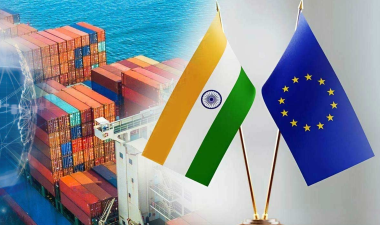
After nearly 25 years of negotiations marked by repeated breakdowns and revivals, India and the European Union have concluded a long-elusive trade agreement. The breakthrough is significant not merely for what it does on tariffs and market access, but for what it signals strategically: a recalibration of India–EU relations at a moment when the global order is under visible strain from geopolitical rivalry, economic coercion, and institutional fragility.
Why this agreement matters beyond trade
The India–EU trade agreement represents a strategic inflexion point rather than the endpoint of a technical negotiation. For years, talks stalled over regulatory standards, market access, and political hesitations on both sides. That these obstacles have now been overcome suggests a deeper convergence of interests.
In an international environment shaped by uncertainty and conflict, the deal positions India and the European Union as partners seeking stability through diversification — of markets, supply chains, and strategic dependencies.
Political trust built through summit diplomacy
One driver of the breakthrough has been sustained high-level political engagement over the last decade. Beginning with Prime Minister ’s visit to Brussels in 2016, India and the EU invested in frequent leader-level interactions, including the India–EU Leaders’ Summit in 2021.
This continuity helped build political trust, allowing negotiators to address issues that had repeatedly derailed talks since 2007. On the Indian side, the government chose to work with domestic stakeholders and manage protectionist concerns, making the case that the EU represents a qualitatively different partner from China. Earlier trade agreements with the UK and Australia created negotiating momentum and helped identify domestic red lines.
On the European side, clearer political guidance from the European Commission and the Council enabled Brussels’ traditionally risk-averse bureaucracy to move beyond rigid free trade templates. Political direction, rather than technical ingenuity alone, proved decisive.
Geopolitics as the stronger catalyst
More than domestic politics, however, geopolitics provided the decisive push. The deal is a response to a rapidly fragmenting international system, shaped by US trade unilateralism, China’s economic coercion, and Russia’s destabilising behaviour.
In this context, the India–EU agreement is best seen as a hedge against systemic risk. It reflects a shared interest in reducing overdependence on a narrow set of partners and strengthening economic security through diversified, trusted relationships.
From economic deal to strategic realignment
While trade provided the entry point, it cannot sustain the partnership on its own. If the relationship remains limited to tariffs and market access, it risks becoming a tactical adjustment rather than a durable strategic shift.
To deepen convergence, India and the EU must operationalise other pillars of their strategic partnership outlined at the recent summit. Defence and security cooperation is one such area. Both sides have stakes in maritime stability, freedom of navigation, and security capacity-building in the Indo-Pacific. Opportunities exist for joint exercises, information sharing, and closer alignment between defence industrial interests, financing, and technology.
Energy cooperation and climate convergence
Energy is another critical domain. Europe’s search for energy diversification and decarbonisation aligns with India’s need for affordable, scalable, and sustainable energy. Joint investment in renewable energy, green hydrogen, and resilient energy infrastructure could anchor long-term interdependence while advancing shared climate objectives.
Such cooperation would also allow both sides to reduce vulnerabilities arising from geopolitical disruptions in energy markets.
Technology, standards, and strategic autonomy
Technology may prove the most consequential frontier of all. As global technology governance fragments along geopolitical lines, India and the EU have an opportunity to shape standards and norms that balance innovation with democratic values.
Cooperation in semiconductors, digital public infrastructure, artificial intelligence, and data governance could reduce mutual dependencies on concentrated supply chains and enhance strategic autonomy. Unlike transactional trade, technological collaboration has the potential to lock in long-term alignment.
Mobility and people-to-people depth
Strategic partnerships ultimately require societal foundations. Mobility of students, researchers, and skilled professionals will be essential to translating political convergence into economic and technological depth.
Addressing long-standing frictions over visas, qualifications, and professional recognition would strengthen innovation ecosystems on both sides and deepen people-to-people ties, making the partnership more resilient to political cycles.
A chance to operationalise multipolarity
India and the EU now have an opportunity to give concrete meaning to their shared rhetoric on multipolarity, a concept both have endorsed since the early 2000s. Working with other middle powers, they can contribute to an international order rooted in openness, resilience, and shared democratic values.
Such a partnership would need to deliver tangible public goods — from maritime security in the Indo-Pacific to development cooperation in the Global South — rather than remain confined to declaratory alignment.
What to note for Prelims?
- India–EU trade talks began in the mid-2000s and stalled multiple times.
- The EU is India’s key trading partner and regulatory power.
- The deal reflects economic as well as geopolitical considerations.
- Summit diplomacy played a key role in reviving negotiations.
What to note for Mains?
- Analyse the strategic significance of the India–EU trade agreement beyond tariffs.
- Discuss how geopolitics is reshaping trade and economic partnerships.
- Examine the scope for India–EU cooperation in defence, energy, and technology.
- Assess the role of middle-power partnerships in a fragmenting global order.