
Daily Activities

UPSC Prelims Current Affairs

UPSC Mains Current Affairs

Current Affairs

India–Indonesia Comprehensive Strategic Partnership

India–Indonesia Comprehensive Strategic Partnership

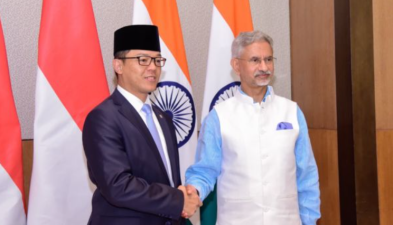
External Affairs Minister S. Jaishankar and Indonesian Foreign Minister Sugiono co-chaired the 8th India–Indonesia Joint Commission Meeting in New Delhi on June 7, 2026. The high-level dialogue focused on reviewing and accelerating the bilateral Comprehensive Strategic Partnership, which was elevated during Prime Minister Narendra Modi’s visit to Jakarta in 2018. This session served to advance commitments established during the state visit of Indonesian President Prabowo Subianto in January 2025. The discussions directly map out the strategic roadmap for Prime Minister Modi’s upcoming diplomatic visit to Jakarta, which aims to expand regional security, trade investments, and technological cooperation across the Indo-Pacific corridor.

Geopolitical and Historical Foundations

The diplomatic architecture between India and Indonesia relies on long-standing civilizational links and shared anti-colonial histories.

Evolution of Diplomatic Ties
  • The Post-Colonial Baseline: Both nations acted as the primary architects of Asian-African solidarity during the mid-20th century. This ideological partnership culminated in the Bandung Conference of 1955 and the subsequent structural founding of the Non-Aligned Movement (NAM) in 1961.
  • Strategic Upgrades: The bilateral equation transformed from a standard Strategic Partnership signed in 2005 to a Comprehensive Strategic Partnership in 2018, expanding the operational mandate across maritime security, defense production, and technological infrastructure.
  • Act East Integration: Indonesia serves as a central geographic and economic pillar of India’s Act East Policy and its broader Indo-Pacific Oceans Initiative (IPOI).

Defense and Maritime Security Cooperation

Defense relations have expanded from basic institutional dialogues to operational interoperability in the critical sea lanes of the Indian Ocean.

Operational Security Matrix
  • Joint Defense Cooperation Committee (JDCC): Regular high-level meetings guide technical transfers and military industrial alignments between New Delhi and Jakarta.
  • Institutional Security Dialogues: Security cooperation runs on specialized tracks, managed by the Joint Working Group on Counter-Terrorism, which held its 6th formal session in Jakarta in August 2024.
  • Bilateral Military Exercises: The two militaries regularly execute bilateral drills to improve combat coordination. This includes Exercise Samudra Shakti for naval assets and Exercise Garuda Shakti for specialized army components.
  • Coordinated Patrols (CORPAT): The Indian Navy and the Indonesian Navy execute bi-annual coordinated patrols along the International Maritime Boundary Line to secure global shipping channels and check transnational maritime crimes.

Economic, Trade, and Infrastructure Ties

Bilateral economic frameworks have diversified from primary commodities into advanced technology, critical industrial inputs, and financial technology platforms.

Bilateral Trade Dynamics
Sector / DimensionOperational Framework & Metrics
Trade VolumeIndonesia is India’s largest trading partner within the ASEAN economic bloc, with annual bilateral trade regularized above 35 billion dollars.
Primary Indian ImportsDominated by crude palm oil, thermal coal, rubber, and chemical inputs.
Primary Indian ExportsConsists of refined petroleum products, organic chemicals, agricultural vehicles, iron and steel products, and commercial pharmaceutical compounds.
Fintech and Digital LinksJoint working groups are designing cross-border digital payment systems to link India’s Unified Payments Interface (UPI) with Indonesian domestic digital payment networks.
Industrial Supply StabilityThe 2026 bilateral understandings created dedicated import mechanisms for chemical fertilizers, essential pharmaceuticals, and critical minerals required for semiconductor manufacturing.

Regional Connectivity and Infrastructure

Physical and institutional connectivity projects focus on linking India’s Andaman and Nicobar Islands directly with Indonesia’s Aceh province to create an integrated economic sub-region.

Sabang Port Development
  • Strategic Location: The deep-sea port of Sabang sits at the mouth of the Malacca Strait, one of the world’s busiest maritime choke points.
  • Joint Infrastructure Investment: India and Indonesia are working together to develop port infrastructure at Sabang to improve economic shipping corridors and boost maritime connectivity between the Andaman Sea and Sumatra.

Multilateral Coordination and ASEAN Alignment

The partnership serves to balance changing geopolitical dynamics in Southeast Asia by supporting multilateral governance and rules-based maritime frameworks.

ASEAN-India Framework
  • Centrality Principle: India’s Act East mechanisms rely on ASEAN Centrality to maintain stability in the Indo-Pacific.
  • Strategic Plan (2026-2030): The 2026 JCM advanced the technical goals of the ASEAN-India Comprehensive Strategic Partnership Plan of Action, standardizing joint operations in digital public infrastructure, humanitarian assistance, and disaster relief.

IASPOINT Booster Facts for UPSC

  • The Exclusive Economic Zone (EEZ) Proximity: India and Indonesia share a maritime boundary. India’s southernmost territory, Indira Point on Great Nicobar Island, lies just 92 nautical miles away from Indonesia’s northernmost point, Rondo Island in Aceh province.
  • The 1950 Republic Day Connection: President Sukarno of Indonesia was the historic first Chief Guest at India’s inaugural Republic Day celebrations on January 26, 1950.
  • The Prabowo Subianto Visit: Continuing this institutional tradition, Indonesian President Prabowo Subianto visited New Delhi as the Chief Guest for India’s Republic Day celebrations in January 2025.
  • Project Mausam Alignment: India’s Project Mausam, managed by the Ministry of Culture, links directly with Indonesian archaeological and maritime tracking systems to document historical trade networks across the Indian Ocean world.
  • Ramayana Cultural Convergence: The Kakawin Ramayana is Indonesia’s localized Old Javanese rendering of the traditional Indian epic, demonstrating deep historical cultural ties that support modern tourism and educational exchange tracks.
Last Modified: June 8, 2026

Leave a Reply

Your email address will not be published. Required fields are marked *

Archives