
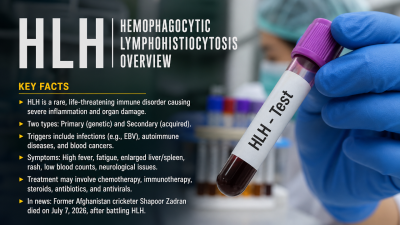
Former Afghanistan fast bowler Shapoor Zadran died on 7 July 2026 after a prolonged illness from Hemophagocytic Lymphohistiocytosis (HLH); he had been treated in New Delhi since January 2026.
Definition & Types
- HLH: A hyperinflammatory syndrome caused by uncontrolled activation of lymphocytes and macrophages leading to tissue phagocytosis and systemic inflammation.
- Primary (Familial): Inherited forms due to mutations in cytotoxicity genes (eg. PRF1, UNC13D, STX11, STXBP2); often presents in infancy/early childhood.
- Secondary (Acquired): Triggered by infections (notably EBV), malignancies (lymphoma), autoimmune disorders, or drugs; occurs at any age.
Clinical Features & Triggers
- Core features: Persistent high fever, splenomegaly, cytopenias, jaundice, rash, neurological signs, multi-organ dysfunction.
- Common triggers: Viral infections (EBV), bacterial/fungal infections, haematological malignancies, systemic rheumatic disease.
Diagnosis
- HLH-2004 criteria: Diagnosis requires 5 of 8: fever, splenomegaly, cytopenias, hypertriglyceridaemia and/or hypofibrinogenaemia, haemophagocytosis, low/absent NK-cell activity, ferritin ≥500 µg/L, elevated soluble CD25 (sIL‑2R).
- Key tests: Ferritin (often markedly raised), fasting triglycerides (≥265 mg/dL), fibrinogen (≤1.5 g/L), bone marrow biopsy, NK-cell assays, genetic sequencing.
Treatment & Prognosis
- Initial therapy: Immunosuppression (dexamethasone), etoposide-based protocols (eg. HLH‑94/HLH‑2004), ciclosporin.
- Advanced options: Haematopoietic stem cell transplant for familial or refractory disease; targeted agents include emapalumab (anti‑IFNγ) and JAK inhibitors in selected cases.
- Supportive care: Antimicrobials, transfusions, organ support for multi‑organ failure.
IASPOINT Booster Facts
- Pathophysiology: Defective cytotoxic T‑cell/NK‑cell function leads to unchecked macrophage activation and cytokine storm.
- Public health: Consider HLH in severe sepsis-like presentations with very high ferritin and unexplained cytopenias.