
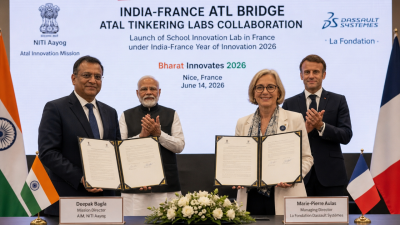
India and France launched the India‑France ATL Bridge on 14 June 2026 at Bharat Innovates 2026 in Nice, formalised by a Letter of Intent between Atal Innovation Mission (AIM), NITI Aayog, and La Fondation Dassault Systèmes.
Key features
- Objective: Use the Atal Tinkering Lab (ATL) school‑lab model to enable cross‑border innovation programmes, entrepreneurial exchanges, capacity‑building and joint student projects.
- LoI parties: Atal Innovation Mission (AIM), NITI Aayog and La Fondation Dassault Systèmes signed the Letter of Intent in Nice.
- First lab in France: Inaugural School Innovation Lab to be established in France under the ATL Bridge.
- Tech focus: Practical exposure to robotics, artificial intelligence, 3D printing, microelectronics and design thinking.
- Diplomatic context: Initiative is part of the India‑France Year of Innovation 2026.
ATL model facts
- Origin and scale: AIM launched the ATL programme in 2016; over 10,000 ATLs established across India, reaching more than 11 million students.
- Target group: School‑level makerspaces aimed primarily at students (typically classes 6–12) for hands‑on STEM learning and prototyping.
- Typical components: Makerspace equipment includes kits, 3D printers, microcontrollers and prototyping tools for iterative design.
IASPOINT Booster Facts
- Institutional anchor: AIM operates as a flagship mission under NITI Aayog for school innovation policy and implementation.
- Implementation mechanism: ATL deployment in India has used partnerships with state education bodies and school managements via MoUs/LoIs.
- Exam relevance: Model illustrates internationalisation of a national flagship education mission and bilateral innovation cooperation frameworks.