
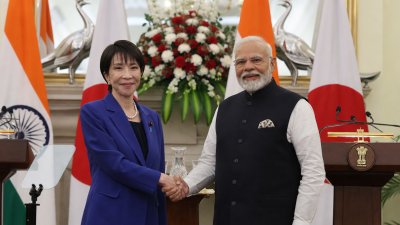
At the 16th India‑Japan Annual Summit on 2 July 2026 the two countries announced 16 outcomes to deepen cooperation in AI, economic security, clean energy, critical minerals, mobility, biotechnology and finance.
Key Agreements
- Joint Statement on AI: Declares AI a general‑purpose technology and establishes a strategic AI R&D partnership for safe, secure, trustworthy and human‑centric AI.
- Joint Declaration on Economic Security: Roadmap to enhance supply‑chain resilience in semiconductors, critical minerals, ICT (including AI), clean energy and pharmaceuticals.
- India‑Japan CBG Initiative: Memorandum to set up 1,000 biogas and organic fertiliser plants across India via dairy cooperatives (CBG = Cooperative Biogas for Growth).
- Energy Resilience Cooperation: Workstreams on stockpiling systems and reserve mechanisms for crude oil and petroleum products.
- Industrial Partnerships: Japanese firms expanding semiconductor links; Fujifilm plans semiconductor materials project in Dholera (target ~2028).
- Green Ammonia Plan: Joint production target ~400,000 tonnes/year using renewable‑derived hydrogen.
- Institutional MoUs: Collaborations between IIT Bombay, C‑CAMP, NCBS‑TIFR and Japanese bodies (RIKEN, National Institute of Informatics) in deep‑tech, life sciences, neuroscience and AI.
Strategic Targets & Numbers
- AI Mobility Target: Invite 500 highly skilled Indian AI professionals to Japan by 2030.
- Trade & Investment (FY 2025‑26): Bilateral trade ~USD 27.5 billion; Japanese investment ~USD 3.2 billion (Apr–Dec 2025).
- Agreements & Investment Pipeline: >100 business agreements recently; expected new Japanese investment ~USD 10 billion; decade objective ~USD 62.11 billion.
IASPOINT Booster Facts
- Economic Security Scope: Covers manufacturing, critical minerals, resilient ICT, strategic stockpiles and pharmaceutical supply chains.
- CBG Technical Output: CBG projects produce compressed biogas for fuel and bio‑based organic fertiliser as by‑product.
- AI R&D Focus Areas: Joint work on trustworthy AI, dataset governance, model safety and human‑centric standards.