
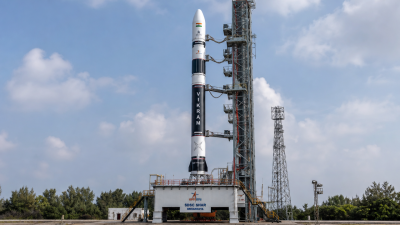
Vikram‑1, Skyroot Aerospace’s first privately developed orbital‑class rocket, is scheduled for Test Flight‑1 “Mission Aagaman” in a launch window from 12 July to 4 August 2026 from Satish Dhawan Space Centre, Sriharikota.
Vehicle and mission profile
- Configuration: Seven‑storey, multi‑stage orbital launch vehicle with an all‑carbon composite structure.
- Payload capacity: Up to 350 kg to Low Earth Orbit (LEO); classed for small satellites.
- Target orbit: 450 km altitude, 60° inclination.
- Primary objectives: In‑flight validation of propulsion, stage separation, guidance, navigation and control (GNC), and overall vehicle performance.
- Flight nature: Partially commercial; carries a mix of domestic and international customer payloads.
Launch infrastructure and authorisation
- Launch site: First Launch Pad, Satish Dhawan Space Centre (SDSC SHAR), Sriharikota.
- Regulatory support: Mission conducted with acknowledgement of ISRO support and authorisation from IN‑SPACe (Indian National Space Promotion and Authorisation Centre).
- Operational readiness: Vehicle was reported flight‑ready and integrated at the launch pad ahead of the window.
Programme background
- Predecessor flight: Vikram‑S suborbital on 18 November 2022 — first privately built rocket from India to reach space.
- Commercial plan: Skyroot intends to commence regular commercial operations after one or two successful orbital demonstrations.
IASPOINT Booster Facts
- IN‑SPACe: Acts as the nodal agency for private sector space authorisations and interface with ISRO.
- SDSC SHAR: ISRO’s primary orbital launch centre on India’s east coast; supports polar and inclined LEO launches.
- Small‑launcher trend: Composite structures and staged propulsion are common design choices to optimise mass and performance for small‑sat launchers.