
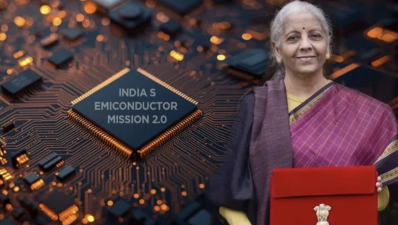
India has launched India Semiconductor Mission 2.0 under the Union Budget 2026–27 to strengthen domestic chip capabilities and reduce dependence on external supply chains. The new phase builds on earlier progress under ISM 1.0 and places greater emphasis on semiconductor equipment, materials, design intellectual property, advanced manufacturing, and skilled manpower. A provision of ₹1,000 crore has been made for ISM 2.0 in FY 2026–27, alongside a broader modified programme with an outlay of ₹8,000 crore.
Mission Focus and Policy Direction
ISM 2.0 is designed to move India from ecosystem creation to ecosystem consolidation. It aims to support the full semiconductor value chain, including fabrication, assembly, testing, packaging, and design. The mission also seeks to encourage industry-led research and training centres. This is intended to build a future-ready workforce and improve India’s technological self-reliance.
Progress Under ISM 1.0
India Semiconductor Mission 1.0 was approved in December 2021 with an incentive framework of ₹76,000 crore. It provides fiscal support of up to 50 per cent for silicon fabs, compound semiconductor facilities, ATMP/OSAT units, and chip design. As of December 2025, 10 projects worth ₹1.60 lakh crore had been approved across six states. These include silicon fabs, silicon carbide fabs, advanced packaging units, and testing facilities.
Targets for 2026–27
The modified programme for 2026–27 sets specific targets across key segments:
- One semiconductor fab with ₹4,000 crore investment and 1,500 jobs.
- Nine units in compound semiconductors, silicon photonics, sensors, and packaging with ₹11,000 crore investment and 3,000 jobs.
- Thirty design companies supported under the Design Linked Incentive Scheme.
- Development of 10 semiconductor IP cores and employment of 200 design professionals.
Strategic Importance for India
Semiconductors are critical for telecommunications, defence, automobiles, healthcare, energy systems, and artificial intelligence. Global supply shocks during the COVID-19 period exposed the risks of concentrated chip manufacturing. With Taiwan, South Korea, Japan, China, and the United States dominating the sector, India’s mission aims to build resilience, attract investment, and strengthen its role in the global semiconductor value chain.
Last Modified: April 28, 2026