
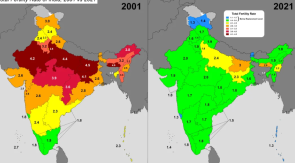
India’s Total Fertility Rate (TFR) has declined to 1.9 in 2024, falling below the replacement level of 2.1, according to the Sample Registration System (SRS) Statistical Report 2024 released by the Ministry of Home Affairs. This shift marks a major demographic transition for the country. While rural areas maintain a TFR exactly at the replacement level of 2.1, urban regions have dropped significantly to 1.5. Accompanying this fertility decline, institutional deliveries across India have risen to 95.4%, indicating vastly improved access to maternal healthcare facilities and safer childbirth practices nationwide.
Understanding Total Fertility Rate and Replacement Level
Total Fertility Rate represents the average number of children a woman would have during her reproductive years (ages 15 to 49) based on current age-specific fertility rates. The replacement level fertility is the specific TFR at which a population exactly replaces itself from one generation to the next without migration. Globally, this baseline is set at 2.1. A TFR lower than 2.1 leads to an eventual contraction of the population size over time, alongside an increasing proportion of elderly citizens.
Key Findings of the SRS Statistical Report 2024
The 2024 report highlights stark regional and socio-economic disparities in fertility trends across Indian states and territories.
Rural versus Urban Divide
- Rural TFR: 2.1 (reaching the exact replacement threshold).
- Urban TFR: 1.5 (well below the replacement threshold).
State-Wise Variations
The demographic transition is not uniform across India, creating a clear divide between northern and southern states.
| State / UT | TFR Value | Category |
| Bihar | 2.9 | Highest TFR in India |
| Uttar Pradesh | 2.4 | Above Replacement Level |
| Jharkhand | 2.2 | Above Replacement Level |
| Kerala | 1.7 | Below Replacement Level |
| Tamil Nadu | 1.6 | Below Replacement Level |
| Delhi | 1.2 | Lowest TFR in India |
Historical Trajectory of India’s TFR
India has experienced a continuous decline in fertility over the past five decades due to targeted family planning programs, rising literacy, and urbanization.
- 1971: 5.2
- 1981: 4.5
- 1991: 3.6
- 2001: 3.1
- 2011: 2.4
- 2024: 1.9
Factors Driving the Decline in Fertility
Multiple socio-economic and healthcare factors have combined to lower the fertility rate across all communities.
Higher Female Literacy and Marriage Age
Increased enrollment of women in higher education postpones the age of marriage and the birth of the first child. Educated women generally prefer smaller family sizes and possess higher autonomy in reproductive choices.
Expansion of Maternal Healthcare
The surge in institutional deliveries to 95.4% reflects better penetration of government healthcare schemes. Higher child survival rates reduce the historical need for larger families to ensure security in old age.
Urbanization and Economic Pressures
Urban living involves higher costs of child-rearing, housing shortages, and a surge in nuclear family setups. The rising participation of women in the formal workforce also influences family size decisions.
Contraceptive Prevalence
Widespread availability and awareness of modern contraceptive methods have reduced unplanned pregnancies across both rural and urban areas.
Socio-Economic Implications of Sub-Replacement Fertility
The drop in TFR below 2.1 triggers long-term structural changes in India’s economy and society.
Demographic Dividend Window
India currently possesses a large working-age population relative to dependents. However, this window is time-bound. As fertility drops, the working-age cohort will eventually shrink.
The Aging Challenge
Southern states are experiencing aging populations much faster than northern states. This creates a disproportionate burden on healthcare infrastructure, social security systems, and senior care facilities.
Labour Market Shifts
Future decades will witness a tightening of the low-skilled labour supply, driving the need for automation, higher skill development, and potential internal migration from high-TFR northern states to low-TFR southern states.
IASPOINT Booster Facts for UPSC
- Sample Registration System (SRS): It is a large-scale demographic survey conducted by the Office of the Registrar General & Census Commissioner under the Ministry of Home Affairs. It provides annual estimates of infant mortality rate, birth rate, death rate, and TFR.
- National Family Health Survey (NFHS-5): The previous major data release from NFHS-5 (2019-21) had already recorded India’s TFR at 2.0, confirming the downward trajectory validated by the SRS 2024 report.
- First Country: India was the first country in the world to launch a National Programme for Family Planning in 1952.
- Demographic Momentum: Even with a TFR below 2.1, India’s population will continue to grow for a few decades due to “population momentum”—the high absolute volume of young people currently entering their reproductive years.
- Janani Suraksha Yojana (JSY) and Janani Shishu Suraksha Karyakram (JSSK): These central government schemes provide cash incentives and free transport/drugs to promote institutional deliveries, directly contributing to the 95.4% institutional delivery rate.