
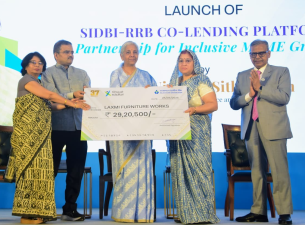
Union Finance Minister Nirmala Sitharaman launched a suite of digital platforms and developmental programs during the 37th Foundation Day celebrations of the Small Industries Development Bank of India (SIDBI) in Mumbai on May 25, 2026. The newly introduced mechanisms target structural credit gaps, technological obsolescence, and fragmented market linkages within the Micro, Small, and Medium Enterprises (MSME) sector. These interventions align with the broader fiscal strategy to shield domestic enterprises from ongoing West Asian geopolitical shocks while systematically building local manufacturing depth for rural and micro-scale operations.
Digital Transformation and Credit Architecture
The structural upgrades focus on automating loan approvals, reducing transaction costs, and creating transparent procurement channels for manufacturing equipment.
SIDBI MachFin Mart
This platform operates as a centralized, investment-ready digital business-to-business (B2B) marketplace designed to help small businesses upgrade their assembly lines.
- Mechanism: It integrates machinery discovery directly with institutional financing options.
- Function: The portal facilitates transparent price discovery, standardizes vendor evaluation, and allows buyers to secure low-interest asset loans directly through backend credit channels.
- Target: It aims to accelerate capital investment by systematically replacing manual, low-efficiency tools with automated technologies.
SIDBI-RRB Co-Lending Platform
This digital joint lending infrastructure links the institutional capital and risk-assessment models of SIDBI with the localized, grassroots operational footprint of Regional Rural Banks (RRBs).
- Risk-Sharing Framework: Loans are co-issued by both institutions, blending low-cost central funds with regional banking outreach to lower borrowing rates for rural applicants.
- Digital Underwriting: The platform cuts down loan turnaround times by replacing manual, physical paperwork with automated digital credit scoring sheets.
- Data Integration: It features a unified tracking dashboard that provides central regulators and state financial units with real-time, district-level data on credit distribution patterns.
Micro Credit Card Scheme
Designed explicitly for micro-scale enterprises to address immediate working capital stress.
- Eligibility: Open to all micro-enterprises registered under the government’s Udyam portal.
- Credit Limit: Offers a revolving operational credit line of up to Rs 5 lakh.
- Collateral Terms: The scheme waives the requirement for primary physical security, relying instead on a 75% credit guarantee coverage framework.
Rural Enterprise Modernization Framework
The developmental strategy shifts toward upgrading non-farm traditional industries through localized, group-based interventions.
Modernisation of Rural Enterprises (MoRE) Programme
This targeted, transformational three-year framework operates from 2026 to 2029 to upgrade traditional occupational structures across rural India.
- Scale Target: The program targets the complete operational modernization of 10,000 rural micro and artisanal units.
- Sector Focus: Core beneficiaries include non-farming rural activities such as traditional jaggery processing units, oil expellers, village pottery setups, decentralized flour mills, and brass artisan workshops.
- Intervention Style: It deploys cluster-based operations, providing grouped entities with combined access to technology, specialized credit lines, and direct commercial market linkages to scale up regional output.
Macroeconomic Indicators and Global Shocks
The policy rollouts occur against a backdrop of steady domestic fiscal indicators balanced against volatile global commodity pressures.
| Economic Parameter | Status / Value | Policy Implications |
| Manufacturing & Output Contribution | ~35% of total manufacturing output | Demands high domestic technological self-reliance. |
| Export Competitiveness | ~48% of total Indian exports | Vulnerable to global maritime and trade route disruptions. |
| GDP Composition | ~31% of national GDP | Central to overall economic stability. |
| Employment Base | Over 32 crore individuals across 7.47 crore units | Acts as the primary absorber of demographic dividend. |
| GST Revenue Trend | 8.3% year-on-year growth | Indicates resilient domestic consumption and transaction volume. |
| Geopolitical External Pressures | Elevated global crude oil, gold, and fertilizer prices | Requires strict foreign exchange conservation and fiscal caution. |
IASPOINT Booster Facts for UPSC
- SIDBI Statutory Profile: Established on April 2, 1990, under an Act of the Indian Parliament, SIDBI acts as the principal financial institution for executing, financing, and developing MSMEs, functioning under the Department of Financial Services, Ministry of Finance.
- Capital Infusion Mandate: The Union Cabinet in January 2026 approved a direct equity capital infusion of Rs 5,000 crore into SIDBI, specifically tasked with onboarding 25 lakh new micro and small business beneficiaries by the year 2028.
- The “Three Fs” Directive: Amid the 2026 West Asian security crisis, the Ministry of Finance issued a specific macroeconomic caution focusing on the monitoring and optimization of Fuel, Fertilizer, and Forex (Foreign Exchange reserves) to protect the domestic balance of payments.
- Emergency Relief Linkage: To shield enterprises from international logistics friction and rising input prices, the government extended support via the Emergency Credit Line Guarantee Scheme (ECLGS 5.0) alongside these digital launches.
- MSME Legal Redefinition History: Under the MSMED Act, 2006 (amended in 2020), India eliminated the distinction between manufacturing and service sectors, implementing a composite criteria based on Investment and Turnover:
- Micro: Investment less than Rs 1 crore; Turnover less than Rs 5 crore.
- Small: Investment less than Rs 10 crore; Turnover less than Rs 50 crore.
- Medium: Investment less than Rs 50 crore; Turnover less than Rs 250 crore.