
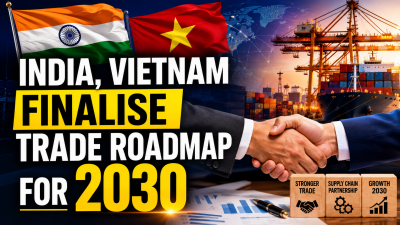
India and Vietnam finalized a strategic trade roadmap on May 6, 2026, targeting a bilateral trade volume of 25 billion United States dollars by 2030. This development occurred during a high-level meeting between Prime Minister Narendra Modi and Vietnamese President To Lam in New Delhi. The discussions resulted in elevating their relationship to an Enhanced Comprehensive Strategic Partnership. Bilateral trade between the two nations reached over 16 billion United States dollars in the fiscal year ending March 2026, doubling over the past decade. The roadmap focuses on market access, supply chain resilience, and digital financial integration to deepen economic engagement in South-East Asia.
Key Agreements and Market Access
Agriculture and Fisheries
- Mutual Market Access: Both nations cleared regulatory pathways for specific fruit exports. India will export grapes and pomegranates to Vietnam, while Vietnam will export durians and pomelos to India.
- Trade Facilitation: The agreement simplifies sanitary and phytosanitary compliance to ease the export of Indian agricultural, fisheries, and animal products to the Vietnamese market.
Pharmaceuticals and Healthcare
- Regulatory Synchronization: A Memorandum of Understanding (MoU) signed between the drug regulatory authorities of both countries streamlines approval processes.
- Indian Drug Exports: This institutional mechanism increases the availability of affordable Indian generic medicines and pharmaceutical formulations in Vietnam.
Critical Minerals and Energy Security
- Supply Chain Resilience: Joint initiatives were launched for the exploration, processing, and sourcing of critical minerals and rare earth elements.
- Clean Energy Transition: Cooperation extends to renewable energy development, power infrastructure modernization, and energy efficiency technologies to support green industrial growth.
Financial Connectivity and Trade Frameworks
Digital Payment Integration
- Cross-Border Fintech: India and Vietnam agreed to link India’s Unified Payments Interface (UPI) with Vietnam’s fast payment system.
- Central Bank Collaboration: Closer institutional mechanisms between the Reserve Bank of India and the State Bank of Vietnam will govern this linkage to reduce transaction costs and time for cross-border remittances and trade settlements.
Regional Trade Architecture
- AITIGA Upgrade: The two countries committed to finishing the review and updating the Association of Southeast Asian Nations (ASEAN)-India Trade in Goods Agreement (AITIGA) by the end of 2026.
- Trade Deficit Mitigation: The renegotiation seeks to establish a more balanced trade framework, addressing India’s widening trade deficit with the ASEAN region which crossed 40 billion United States dollars.
Bilateral Trade Profile
| Export Category from India | Import Category from India |
| Iron and steel | Electronic equipment and components |
| Machinery and mechanical appliances | Mobile phones and spare parts |
| Pharmaceuticals and organic chemicals | Machinery and mechanical appliances |
| Marine products and animal feed | Rubber and plastic articles |
| Cotton and primary plastics | Coffee, tea, and spices |
IASPOINT Booster Facts for UPSC
- Enhanced Comprehensive Strategic Partnership: Vietnam is one of the few nations with which India shares this elevated status. It forms a key pillar of India’s Act East Policy and the Indo-Pacific Oceans Initiative (IPOI).
- Geopolitical Alignment: Vietnam acts as a vital maritime neighbor in the South China Sea. Both nations support freedom of navigation and overflight based on the United Nations Convention on the Law of the Sea (UNCLOS).
- AITIGA Genesis: The ASEAN-India Trade in Goods Agreement was originally signed in 2009 and came into effect in 2010. The 2024–2026 renegotiations aim to add product-specific rules and eliminate non-tariff barriers.
- Sub-national Diplomacy: The 2026 joint statement introduced framework agreements to encourage direct State-to-State and City-to-City economic and cultural cooperation.
- Fintech Footprint: With this agreement, Vietnam joins a growing list of countries, including Singapore, UAE, Mauritius, and Sri Lanka, that have integrated with India’s UPI network for cross-border financial transactions.