
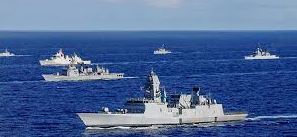
The Indian Navy’s biannual Commanders’ Conference 2026 was held at Nausena Bhawan, New Delhi, from 14 to 16 April 2026. The three-day apex-level event involved senior naval leadership, including the Chief of the Naval Staff, operational commanders, and addresses by the Chief of Defence Staff and the Home Secretary. The conference reviewed operational posture, capability development, and strategic alignment with national security objectives.
Operational Review and Strategic Focus
The conference assessed naval deployments safeguarding India’s Energy Security amid ongoing West Asia conflicts and Multi-National Forces’ convergence in the Indian Ocean Region. Discussions reaffirmed the Navy’s operational doctrine and inter-services coordination post ‘Op Sindoor’. Emphasis was placed on achieving decisive operational success and enhancing blue-water naval capabilities.
Technology and Innovation
Deliberations included the implementation of the Artificial Intelligence roadmap for Pan Navy solutions and the use of data-driven technologies for seamless operations. The conference reviewed the effective employment of uncrewed systems, operational logistics, and sustainable maintenance practices to improve combat readiness.
Human Resource and Training
The event focused on human resource management and training to strengthen the Navy’s operational efficiency. Strategies to enhance interoperability and jointness with other services were discussed to address multi-dimensional challenges in the current geo-strategic environment.
International Cooperation and Policy Alignment
The Navy’s leadership reviewed efforts to expand international cooperation and support the Government of India’s MAHASAGAR vision. The conference underscored indigenisation, innovation, and the Navy’s preparedness to deliver military success aligned with the Indian Maritime Doctrine’s four roles. The forum aimed to position the Indian Navy as the ‘Preferred Security Partner’ in the Indian Ocean and Indo-Pacific regions.
What to Study for UPSC Exams?
- Indian Maritime Doctrine and Roles
- India’s Energy Security and Maritime Strategy
- Artificial Intelligence in Defence
- Indigenisation in Indian Defence Sector
Indian Maritime Doctrine and Roles
The Indian Maritime Doctrine outlines the strategic framework guiding the Indian Navy’s operations and development. It defines four primary roles: safeguarding national interests, promoting regional stability, protecting sea lines of communication, and supporting national policy. First published in 2004, it is periodically updated to reflect changing geopolitical and technological contexts.
India’s Energy Security and Maritime Strategy
India imports over 80% of its oil via sea routes, making maritime security critical for energy supply. The strategy involves securing sea lines of communication, especially in the Indian Ocean Region, through naval deployments and international partnerships. It integrates naval power with diplomatic and economic measures to ensure uninterrupted energy flow.
Artificial Intelligence in Defence
AI in defence enhances decision-making through data analytics, autonomous systems, and predictive maintenance. It enables real-time threat detection and operational efficiency. Militaries worldwide use AI for uncrewed vehicles, cyber defence, and logistics optimization, with ethical and security challenges under continuous review.
Indigenisation in Indian Defence Sector
Indigenisation aims to reduce dependency on foreign arms by developing domestic defence manufacturing capabilities. Initiatives include the Defence Procurement Procedure (DPP) and ‘Make in India’ campaign. It fosters technology transfer, private sector involvement, and innovation to achieve self-reliance in defence production.
Last Modified: April 12, 2026