
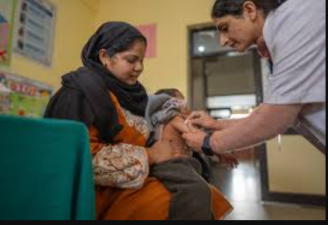
India’s immunisation efforts have made progress in recent years. The Universal Immunisation Programme (UIP) remains the world’s largest, providing free vaccines against 12 diseases. Recent campaigns and technological innovations have boosted coverage and strengthened disease surveillance. Despite challenges, India continues to lead in vaccine development and delivery, setting a global example.
Universal Immunisation Programme Overview
The UIP vaccinates over 2.6 crore infants and 2.9 crore pregnant women annually. It offers protection against 12 diseases through 11 vaccines nationwide and one targeted vaccine in endemic regions. Since 2014, six new vaccines have been added, including Measles-Rubella and Pneumococcal Conjugate vaccines. Under-5 mortality declined from 45 to 31 per 1,000 live births between 2014 and 2021, showing the programme’s impact.
Mission Indradhanush and Coverage Expansion
To increase full immunisation from 62% in 2014 towards 90%, India launched Mission Indradhanush (MI) in 2014 and Intensified MI (IMI) in 2017. These targeted low-coverage and hard-to-reach populations. By 2023, 12 phases vaccinated over 5.46 crore children and 1.32 crore pregnant women. MI and IMI were integrated with Gram Swaraj Abhiyan campaigns for wider outreach. Full immunisation coverage improved notably by 2024–25.
Challenges and Innovative Solutions
Difficulties remain in vaccinating remote, migratory, and hesitant populations. Clusters with low awareness also pose challenges. To address these, India employs ‘zero-dose’ outreach, digital tracking, and infrastructure upgrades. Efforts focus on identifying and reaching missed children and pregnant women to close immunity gaps.
Disease Elimination and Outbreak Response
India has been polio-free since 2011 and eliminated maternal and neonatal tetanus in 2015. It was declared Yaws-free in 2016. The Measles-Rubella catch-up campaign vaccinated 34.8 crore children from 2017 to 2019. COVID-19 disrupted routine immunisation, causing measles outbreaks between 2022 and 2024. The IMI 5.0 and Zero Measles-Rubella Elimination campaign aim to achieve over 95% coverage and herd immunity.
Technological Integration in Immunisation
Digital platforms like U-WIN provide end-to-end vaccination tracking for children and pregnant women. It supports access for migratory populations. Other systems include the electronic Vaccine Intelligence Network and National Cold Chain Management Information System for real-time stock and cold chain management. SAFE-VAC monitors vaccine safety. These tools enhance efficiency and transparency.
India’s Vaccine Development and Global Role
India launched its COVID-19 vaccination programme early in 2021. By January 2023, over 220 crore doses were administered, covering 97% with one dose and 90% fully vaccinated. Domestic vaccine production and public-private partnerships helped meet national and global demand. The Vaccine Maitri initiative supplied vaccines to many low and middle-income countries. India is now the world’s largest vaccine manufacturer under the ‘Make in India’ strategy.
Recognition and Future Directions
India received the Measles and Rubella Champion Award in March 2024 for its regional leadership. It has expanded coverage, strengthened supply chains, and built public trust. Future priorities include integrating human, animal, and environmental disease surveillance with immunisation programmes under a ONE-HEALTH approach. Monitoring anti-vaccine misinformation remains critical for sustained success.
Questions for UPSC:
- Point out the role of digital technology in improving India’s Universal Immunisation Programme and its impact on vaccine coverage.
- Underline the challenges faced in vaccinating migratory and remote populations in India and critically analyse the strategies used to overcome them.
- Estimate the significance of India’s Vaccine Maitri initiative in global health diplomacy and vaccine equity.
- Critically analyse the ONE-HEALTH approach in pandemic preparedness and its relevance to immunisation and disease surveillance systems.