
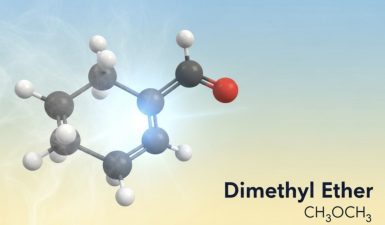
India is the world’s second largest importer of liquefied petroleum gas (LPG) and relies on the Strait of Hormuz for some imports. The ongoing West Asia conflict has disrupted global energy supplies, impacting India’s LPG availability. Dimethyl ether (DME) is identified as a potential substitute or blending agent for LPG, usable in household cooking and industrial fuel applications.
Dimethyl Ether (DME) Characteristics
DME is a colourless gas under normal atmospheric conditions. It is synthetically produced and used in chemical industries, aerosol propellants, solvents, fuels, and refrigerants. DME has a calorific value and thermal efficiency comparable to traditional fuels. It is a clean-burning fuel with low emissions and particulate matter.
Exam Point: DME versus LPG
Dimethyl ether (DME) has a lower calorific value (approx. 28–29 MJ/kg or 6,900 kcal/kg) compared to LPG (approx. 46–50 MJ/kg or 11,000+ kcal/kg). While DME has similar pressure, density, and a burner-compatible flame to LPG, it provides roughly 60% of the energy content by weight, often requiring about 1.5 times more fuel to deliver the same power output.
Key Comparison Points
Calorific Value
- DME has a lower energy density (≈28 MJ/kg) than LPG (≈46 MJ/kg).
Performance
- Due to its lower energy content, a greater quantity of DME is required to achieve the same boiling efficiency in standard burners.
Blending
- DME can be blended with LPG up to 20% by weight without requiring significant stove modifications.
Pressure and Liquid Density
- DME behaves very similarly to LPG in terms of pressure and liquid density, making it a viable drop-in substitute or blending component for existing infrastructure.
Environmental Impact
- DME is considered a cleaner-burning alternative, producing no soot and low emissions.
- It can be produced from waste and biomass, enhancing its sustainability profile.
DME Production and Usage in India
DME can be produced domestically through coal gasification technologies. India currently has limited pilot-scale DME production. The Bureau of Indian Standards (BIS) permits up to 20% blending of DME with LPG. Blending DME with LPG can reduce India’s LPG import dependence by approximately 6.3 million tonnes annually.
Global Context of DME Production
China holds about 90% of the world’s DME production capacity due to its extensive coal-to-chemicals industry. Countries with coal reserves can produce DME domestically via coal gasification, enhancing energy security.
Energy Security and Policy
A clear blending policy is essential to scale domestic DME production and attract investments. Coal gasification for DME production contributes to energy and chemical security by providing an alternative to imported LPG. India’s LPG import dependence can be reduced by blending LPG with up to 20% DME. Domestic coal gasification is a viable method for producing DME in countries with coal reserves.
Last Modified: April 20, 2026