
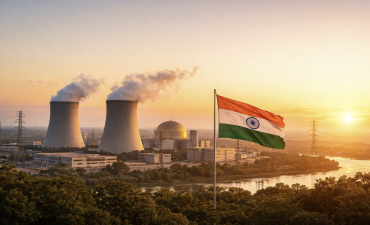
The SHANTI Act 2025 marks a major shift in India’s nuclear energy sector. It opens nuclear power development to public and private players, academia, and industry. The goal is to build a robust ecosystem that meets India’s growing energy needs. This comes amid global challenges in uranium supply and the urgent need for sustainable nuclear fuel cycles.
Current Nuclear Energy Scenario in India
India’s nuclear power capacity depends heavily on imported uranium. Domestic uranium reserves are limited and expensive to extract. The government aims for 100 GWe nuclear capacity by 2047, mostly from thermal reactors needing about 18,000–20,000 tonnes of uranium annually. This demand is about one-third of global uranium production. Globally, nuclear capacity is expected to rise from 380 GWe to 1,400 GWe by 2047. Known uranium resources can sustain this only for about 30 years in once-through mode. This means current uranium use is unsustainable and securing supply will be harder.
Thorium Recycling and Energy Independence
India has the world’s largest thorium reserves. Thorium recycling offers a way to overcome uranium shortages and reduce proliferation risks. Unlike uranium, thorium use is less prone to weaponisation. India’s three-stage nuclear programme focuses on thorium utilisation. Fast Breeder Reactors (FBRs) will produce uranium-233 from thorium, which is vital for the third stage of the programme. Developing thorium-based reactors is urgent and requires innovation and multidisciplinary research.
Fast Breeder Reactors and HALEU Fuel
The Prototype Fast Breeder Reactor (500 MWe) is nearing completion. Metal-fuelled FBRs and fuel recycling technologies are needed for rapid nuclear capacity growth. In the meantime, Pressurised Heavy Water Reactors (PHWRs) can irradiate thorium using HALEU (high-assay low-enriched uranium) fuel. This increases efficiency, safety, and reduces spent fuel. Accelerated irradiation testing of HALEU–thorium fuel is essential but India currently lacks such facilities. International partnerships can help bridge this gap.
Small Modular Reactors and Future Technologies
Thorium Molten Salt Reactors (TMSRs) and Small Modular Reactors (SMRs) are key future technologies. SMRs can also produce green hydrogen via thermochemical processes. Recycling of irradiated thorium and HALEU fuel will use pyrochemical methods. China has advanced in this area, and India aims to catch up. The SHANTI Act ecosystem will support these developments to achieve energy independence.
Topics for Prelims:
SHANTI Act 2025
- Opens nuclear energy sector to public, private, academia.
- Focus on regulatory framework without monopolies.
- Supports India’s 100 GWe nuclear mission by 2047.
- Encourages innovation in nuclear fuel cycles.
- Promotes thorium-based nuclear power development.
Thorium and Fast Breeder Reactors
- India holds largest thorium reserves globally.
- FBRs produce uranium-233 from thorium.
- Prototype Fast Breeder Reactor nearing readiness.
- Thorium recycling reduces proliferation risks.
- Thorium use enhances energy independence.
HALEU and Small Modular Reactors (SMRs)
- HALEU is high-assay low-enriched uranium fuel.
- PHWRs can use HALEU–thorium fuel mix.
- SMRs enable flexible, low-cost nuclear power.
- SMRs can produce green hydrogen via thermochemical routes.
- Pyrochemical recycling supports fuel sustainability.
Questions for Mains:
- Critically analyse the challenges and opportunities of India’s three-stage nuclear power programme in achieving energy security. [GS-III-Economic Development]
- Explain the significance of thorium-based nuclear reactors in India’s energy policy and comment on the global implications of nuclear fuel recycling. [GS-III-Science & Technology]
- With suitable examples, underline the role of regulatory reforms like the SHANTI Act 2025 in encouraging innovation and private sector participation in strategic sectors such as nuclear energy. [GS-II-Governance]
- What are the environmental and geopolitical implications of increasing reliance on imported uranium for nuclear power? How can India’s focus on thorium and advanced reactors address these concerns? [GS-III-Environment & DM]
Answer Hints:
1. Critically analyse the challenges and opportunities of India’s three-stage nuclear power programme in achieving energy security. [GS-III-Economic Development]
- Three-stage programme aims to utilise uranium first, then fast breeder reactors (FBRs), and finally thorium-based reactors for sustainable energy.
- Challenges include limited domestic uranium, high cost of extraction, and dependence on imported uranium for initial stages.
- FBRs are complex, require advanced technology, and the first Prototype Fast Breeder Reactor is still under commissioning.
- Thorium utilisation offers vast energy potential and reduces proliferation risks but requires multidisciplinary innovation and infrastructure development.
- Opportunities include long-term energy independence, maximising India’s large thorium reserves, and reducing uranium supply vulnerabilities.
- Programme supports India’s goal of 100 GWe nuclear capacity by 2047, enabling clean, reliable base-load power to meet growing demand.
2. Explain the significance of thorium-based nuclear reactors in India’s energy policy and comment on the global implications of nuclear fuel recycling. [GS-III-Science & Technology]
- India holds the world’s largest thorium reserves, making thorium-based reactors key to energy independence.
- Thorium reactors produce uranium-233, enabling a sustainable fuel cycle with reduced nuclear waste and proliferation risk.
- Thorium recycling extends fuel life 50- to 100-fold compared to once-through uranium use, enhancing resource efficiency.
- Globally, nuclear recycling faces proliferation concerns; thorium use mitigates these, as it is less suitable for weapons.
- Adoption of recycling technologies can reduce uranium demand, lower radioactive waste, and support climate goals worldwide.
- India’s progress in thorium and fast breeder reactors positions it as a leader in advanced nuclear technology innovation.
3. With suitable examples, underline the role of regulatory reforms like the SHANTI Act 2025 in encouraging innovation and private sector participation in strategic sectors such as nuclear energy. [GS-II-Governance]
- SHANTI Act 2025 opens nuclear sector to public, private players, academia, and industry, breaking previous monopolies.
- It encourages a conducive regulatory framework that encourages competition, innovation, and faster technology adoption.
- Examples – Enabling private investment in nuclear power generation and fuel cycle technologies, including SMRs and thorium reactors.
- Promotes collaboration through international partnerships for technology transfer and research, e.g., HALEU fuel testing.
- Regulatory clarity and support accelerate India’s 100 GWe nuclear mission and development of advanced reactors.
- Such reforms enhance energy security, economic growth, and strategic autonomy in a sensitive sector.
4. What are the environmental and geopolitical implications of increasing reliance on imported uranium for nuclear power? How can India’s focus on thorium and advanced reactors address these concerns? [GS-III-Environment & DM]
- Heavy uranium imports expose India to supply disruptions, price volatility, and geopolitical risks from uranium-exporting countries.
- Mining and transporting uranium have environmental impacts including radiation hazards and ecological disturbance.
- Once-through uranium use generates radioactive waste, posing long-term environmental challenges.
- Thorium-based reactors reduce dependence on imports due to abundant domestic thorium reserves.
- Thorium fuel cycle produces less long-lived radioactive waste and has lower proliferation risk, enhancing environmental safety.
- Advanced reactors like FBRs and SMRs improve fuel efficiency, reduce waste, and support sustainable, secure energy supply.