
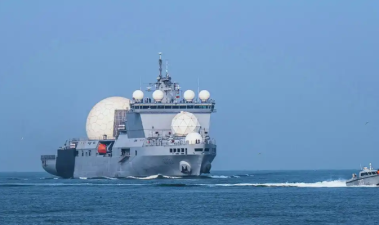
Pakistan’s closure of a large section of the northern Arabian Sea for a suspected missile test has led to a notable intelligence-focused maritime standoff with India. The Indian Navy has deployed INS Dhruv, a specialised missile-tracking and ocean-surveillance vessel, into the region ahead of Pakistan’s declared live-firing window. The development marks the growing role of technical surveillance in South Asian security competition.
Pakistan’s Sea Closure
Pakistan issued a maritime warning and NOTAM for a broad exclusion zone in the Arabian Sea. The restricted area covers waters near Karachi, Ormara, Gwadar and Sonmiani. The closure is in force from 14 April to 15 April and extends from sea level to unlimited altitude. The zone spans roughly 415 km to 450 km, indicating preparations for a major missile-related activity.
INS Dhruv’s Deployment
INS Dhruv entered the Arabian Sea on 13 April, less than 24 hours before the declared test window. The vessel is designed for missile tracking, signals collection and ocean surveillance. Its presence suggests that India intended to monitor the launch closely and gather technical intelligence on the test.
Strategic Significance
The episode reflects a shift in India-Pakistan military competition from visible exercises to real-time surveillance and intelligence gathering. Such deployments allow states to study missile trajectories, telemetry and operational patterns. For both sides, these observations are valuable for assessing capability, readiness and deterrence posture.
Broader Security Context
The incident comes amid continuing tensions in the region and shows how naval assets are increasingly used for strategic monitoring. Missile tests, maritime exclusion zones and surveillance ships are now part of a wider contest involving deterrence, intelligence and crisis signalling in the Arabian Sea.
Last Modified: April 27, 2026