
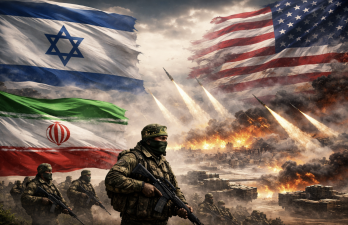
The ongoing conflict between Iran, Israel, and the United States has brought into light Tehran’s primary goal – survival, not victory. Since the war began on 28 February 2026, Iran’s actions reflect a long-standing strategy focused on preserving the Islamic Republic. This approach shapes Iran’s military, political, and diplomatic behaviour amid escalating tensions and military strikes.
Iran’s Survival Imperative
The Islamic Republic of Iran was founded in 1979 with survival as its core principle. Ayatollah Khomeini embedded this doctrine into the state’s constitution. The Islamic Revolutionary Guard Corps (IRGC) was created to protect the revolution rather than national borders. This force operates independently of the regular army. Its loyalty is to the regime, not the nation. The survival doctrine guides Iran’s response to protests, sanctions, proxy wars, and direct military attacks. It aims to hold power, suppress dissent, and outlast enemies.
Leadership and Institutional Continuity
The recent succession of Mojtaba Khamenei as Supreme Leader reinforces this survival logic. His appointment within 10 days of his father’s death ensured continuity in the hardline security establishment. It was a move to protect the regime, defying US objections. This rapid institutional response shows Iran’s resilience and prioritisation of regime stability over external acceptance or pressure.
Israel’s Strategy and US Divergence
Israel views Iran’s survival doctrine as an existential threat. Prime Minister Benjamin Netanyahu demands regime change, not mere nuclear disarmament or degradation. He aims to end the Islamic Republic entirely. The US position is less clear. While militarily aligned with Israel, US policy has vacillated between demanding unconditional surrender and considering a new nuclear deal. This lack of coherence weakens the allied front and offers Iran room to manoeuvre.
Iran’s Expanding War Tactics
Instead of limiting retaliation, Iran has broadened the conflict. It targets Gulf Cooperation Council states, disrupts the Strait of Hormuz, and influences global oil prices. These moves show Iran leveraging its power to increase war costs for its enemies. The regime’s goal is to make its removal too costly, ensuring its survival despite military pressure.
Topics for Prelims:
Islamic Revolutionary Guard Corps (IRGC)
- Founded shortly after 1979 revolution to protect the regime.
- Separate from Iran’s regular army.
- Focuses on internal security and regime preservation.
- Operates proxies in regional conflicts like Hezbollah and Hamas.
- Central to Iran’s military and political strategy.
Mojtaba Khamenei
- Appointed Supreme Leader in 2026 after his father’s death.
- Known for close ties to IRGC and hardline factions.
- Represents continuity of Iran’s survival doctrine.
- Appointment defied US objections.
- Symbolises regime’s institutional resilience.
Israel-Iran Conflict
- Rooted in Iran’s support for anti-Israel groups.
- Israel demands regime change in Iran.
- Conflict includes proxy wars and missile strikes.
- US and Israel differ on war objectives.
- Impact on global oil markets and regional security.
Questions for Mains:
- Critically discuss the role of the Islamic Revolutionary Guard Corps in maintaining the Islamic Republic of Iran’s political stability. [GS-II-International Relations]
- Examine the strategic differences between Israel and the United States in their approach to the Iran conflict and their implications for regional security. [GS-II-International Relations]
- With suitable examples, discuss how survival doctrines shape state behaviour during prolonged conflicts and their impact on diplomatic negotiations. [GS-II-Governance]
- Analyse the geopolitical importance of the Strait of Hormuz in the context of the Iran-Israel-US conflict and its effects on global energy security. [GS-I-World & Physical Geography]
Answer Hints:
1. Critically discuss the role of the Islamic Revolutionary Guard Corps in maintaining the Islamic Republic of Iran’s political stability. [GS-II-International Relations]
- IRGC established soon after 1979 revolution to protect the Islamic regime, distinct from regular army focused on borders.
- Primary loyalty to the regime, tasked with preserving the revolution and political order rather than national defense.
- Suppresses internal dissent, manages protests, and counters external threats to regime survival.
- Controls military, economic, and political influence within Iran, ensuring hardline continuity.
- Operates proxy groups (Hezbollah, Hamas) to extend Iran’s strategic depth and deter adversaries.
- Acts as an institutional pillar enabling regime resilience despite sanctions, protests, and military pressure.
2. Examine the strategic differences between Israel and the United States in their approach to the Iran conflict and their implications for regional security. [GS-II-International Relations]
- Israel demands regime change in Iran, aiming to eliminate the Islamic Republic entirely.
- US policy is ambiguous, oscillating between regime change, nuclear disarmament, and possible diplomatic engagement.
- This divergence weakens allied coherence and strategic clarity against Iran.
- Israel views Iran’s survival doctrine as existential threat; US seeks achievable military objectives and exit strategy.
- Differences risk prolonging conflict, complicating peace efforts, and destabilizing the region further.
- Iran exploits this gap to expand conflict and raise war costs, impacting Gulf security and global energy markets.
3. With suitable examples, discuss how survival doctrines shape state behaviour during prolonged conflicts and their impact on diplomatic negotiations. [GS-II-Governance]
- Survival doctrine prioritizes regime preservation over conventional victory (e.g., Iran’s response to sanctions, protests, and war).
- Leads to strategies of repression, proxy warfare, and calibrated escalation rather than full-scale defeat or surrender.
- Example – Iran’s IRGC focusing on outlasting adversaries by raising war costs (missile strikes, Gulf disruptions).
- Survival logic drives rapid institutional continuity (e.g., swift appointment of Mojtaba Khamenei as Supreme Leader).
- Complicates diplomatic negotiations as regime resists concessions that threaten its core existence.
- Negotiations often stalled or ambiguous due to differing adversary aims and regime’s unwillingness to compromise survival.
4. Analyse the geopolitical importance of the Strait of Hormuz in the context of the Iran-Israel-US conflict and its effects on global energy security. [GS-I-World & Physical Geography]
- Strait of Hormuz is a critical chokepoint for global oil shipments, connecting Persian Gulf to open seas.
- Approximately 20% of global petroleum passes through, making it vital for energy security worldwide.
- Iran’s ability to restrict traffic here is a strategic leverage tool in the conflict.
- Disruptions raise oil prices, impacting global markets and economies.
- Conflict escalation risks broader regional instability affecting international trade routes.
- Control or threat to the Strait influences geopolitical calculations of regional and global powers.