
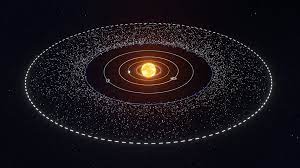
Astronomers have uncovered compelling evidence pointing to the presence of an Earth-like planet within the distant Kuiper Belt of our solar system. The Kuiper Belt, named after Gerard Kuiper, is a ring of small icy celestial bodies beyond Neptune’s orbit. Comprising millions of objects referred to as Kuiper Belt objects (KBOs) or trans-Neptunian objects (TNOs), this region is a remnant of the solar system’s early days and a source of short-period comets. Composed mainly of icy bodies, it includes Pluto, formerly the ninth planet, reclassified as a dwarf planet by the International Astronomical Union (IAU) in 2006 due to its Kuiper Belt location.
Facts/Terms for UPSC Prelims
- Kuiper Belt: The Kuiper Belt is a flat ring of small icy bodies orbiting beyond Neptune, named after Gerard Kuiper. It’s a source of short-period comets and consists of Kuiper Belt objects (KBOs) or trans-Neptunian objects (TNOs).
- Gerard Kuiper: A Dutch-American astronomer who proposed the existence of the Kuiper Belt in the 1950s, and after whom the region is named.
- Kuiper Belt Objects (KBOs): These are the millions of small icy bodies found in the Kuiper Belt, including dwarf planets, asteroids, and comets.
- Trans-Neptunian Objects (TNOs): Another term for celestial objects found in the Kuiper Belt, indicating their location beyond Neptune’s orbit.
- Pluto: Formerly considered the ninth planet, Pluto was reclassified as a dwarf planet by the International Astronomical Union (IAU) in 2006, primarily due to its location within the Kuiper Belt.