
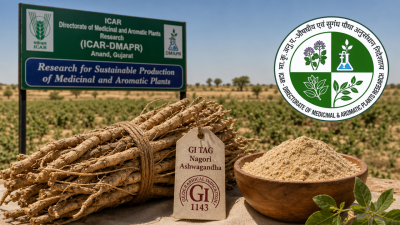
Nagori Ashwagandha from Rajasthan’s Nagaur region received the Geographical Indication tag (GI no. 1143) on 29 June 2026; ICAR‑DMAPR, Anand, provided the scientific evidence used in the GI application. The GI‑tagged root was presented as a traditional Indian gift at the G7 Summit in France.
GI recognition and stakeholders
- GI number & date: GI no. 1143; notified 29 June 2026.
- Applicants/collaborators: Department of Agriculture, Government of Rajasthan; National Medicinal Plants Board (NMPB); Nagori Welfare Society; technical validation by ICAR‑DMAPR.
- NMPB placement: NMPB functions under the Ministry of AYUSH for medicinal plants policy and promotion.
Distinctive agro‑geography and traits
- Cultivation zone: Central and western Rajasthan — Nagaur, Churu, Bikaner.
- Agro‑climatic factors: arid to semi‑arid climate and specific soil characteristics linked to product quality.
- Root morphology: long, thick, brittle, cavity‑free roots specified in the GI dossier.
ICAR‑DMAPR scientific validation
- Phytochemistry: analytical profiling showing richness of withanolides, alkaloids and starch.
- Quality metrics: chemical quality parameters and analytical methods established product standards.
- Therapeutic linkage: research mapped traditional Ayurvedic uses to identified bioactive compounds.
IASPOINT Booster Facts
- Legal framework: Geographical Indications of Goods (Registration & Protection) Act, 1999 governs GI protection in India.
- International norm: TRIPS provides the definition of geographical indication for trade agreements.
- Administration: GI Registry is located in Chennai under DPIIT, Ministry of Commerce & Industry.