
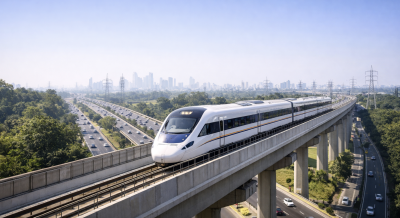
Prime Minister Narendra Modi inaugurated the remaining sections of the Namo Bharat Regional Rapid Transit System (RRTS), making the entire 82-km Delhi–Meerut corridor operational. The launch includes a 5-km stretch between Sarai Kale Khan and New Ashok Nagar in Delhi and a 21-km stretch between Meerut South and Modipuram in Uttar Pradesh. Simultaneously, the Meerut Metro — integrated with the RRTS — was also flagged off, marking a new phase in regional mobility for the National Capital Region (NCR).
What Is the Namo Bharat RRTS?
4
The Namo Bharat Regional Rapid Transit System is India’s first semi-high-speed regional rail network designed for high-frequency, high-speed connectivity between Delhi and adjoining cities. With operational speeds of up to 160 km/h, the system aims to reduce travel time between Delhi and Meerut to under an hour.
The corridor is implemented by the National Capital Region Transport Corporation (NCRTC), a joint venture of the Centre and participating state governments.
Integration with Meerut Metro and Multi-Modal Hubs
A key feature of the project is its integration with the Meerut Metro, allowing seamless transition between regional and intra-city travel.
The Sarai Kale Khan station — the originating station — is emerging as a major multi-modal hub. It connects:
- Hazrat Nizamuddin Railway Station
- Delhi Metro’s Pink Line
- Veer Haqeeqat Rai ISBT
- Major road networks including Ring Road
Similar integration is planned or operational at Anand Vihar, Ghaziabad, and Meerut, creating a unified transport grid linking Indian Railways, metro systems, buses, and rapid rail.
Twin Cities Vision and Regional Decongestion
The Prime Minister described the project as a model for “twin cities” development — where high-speed regional transit allows people to live in one city and work or study in another without relocating.
The implications are significant:
- Reduced pressure on Delhi’s housing market.
- Decongestion of roads and public transport.
- Balanced urban growth across the NCR.
- Improved quality of life through shorter commutes.
This aligns with India’s broader strategy of transit-oriented development (TOD) and polycentric urban planning.
Economic Multiplier and Infrastructure Push
The RRTS complements other major infrastructure investments in the region, including expressways, freight corridors and the upcoming Jewar International Airport.
Such large-scale projects generate:
- Direct employment during construction.
- Indirect opportunities in real estate, services and logistics.
- Increased land value and commercial activity along the corridor.
Rapid transit corridors often catalyse new economic clusters, industrial zones and residential townships.
Future Expansion Plans
Union Housing and Urban Affairs Minister Manohar Lal Khattar indicated that two new RRTS corridors from Sarai Kale Khan are under consideration:
- Sarai Kale Khan to Karnal (Haryana), approximately 125–130 km.
- Sarai Kale Khan to Babarpur (Haryana) and Neemrana (Rajasthan).
If approved, these corridors would further expand the rapid rail network, strengthening inter-state connectivity within northern India.
Environmental and Urban Impact
The corridor is expected to reduce reliance on private vehicles, thereby lowering traffic congestion and carbon emissions. Electrified rapid rail systems contribute to:
- Cleaner air in the NCR.
- Energy-efficient mass transit.
- Reduced fuel consumption.
As Delhi grapples with chronic air pollution and vehicular congestion, modal shift to high-capacity public transport is critical.
What to Note for Prelims?
- Length of Delhi–Meerut RRTS corridor: 82 km.
- Implementing agency: NCRTC.
- Maximum design speed: 160 km/h.
- Concept of multi-modal integration and transit-oriented development.
What to Note for Mains?
- Role of regional rapid transit in decongesting megacities.
- Infrastructure-led growth and employment generation.
- Environmental benefits of mass rapid transit systems.
- Cooperative federalism in multi-state infrastructure projects.