
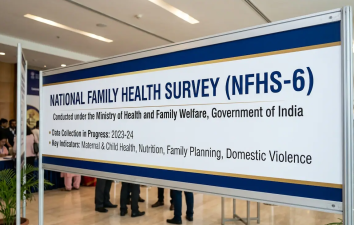
The Union Health Ministry released the National Family Health Survey-6 (NFHS-6) for 2023-24. This comprehensive survey covered 6.79 lakh households across 715 districts in India. It highlights major improvements in maternal and child healthcare, family planning, immunization, and child nutrition when compared to the previous NFHS-5 (2019-21) data. The report details progress in health insurance coverage and women’s digital and financial empowerment. NFHS-6 serves as a vital database for evidence-based policy-making. It tracks India’s advancement towards achieving the Sustainable Development Goals (SDGs) related to health, nutrition, and gender equality.
Institutional Framework and Methodology
The National Family Health Survey is a large-scale, multi-round survey conducted in a representative sample of households throughout India.
- The Ministry of Health and Family Welfare (MoHFW) designates the International Institute for Population Sciences (IIPS) in Mumbai as the nodal agency for conducting the survey.
- The survey provides essential data on health and family welfare needed by the MoHFW and other agencies for policy implementation.
- NFHS-6 expands its reach by collecting data from 6.79 lakh households across 715 districts, ensuring highly granular district-level tracking of health indicators.
Progress in Maternal and Child Healthcare
The latest survey records positive shifts in critical maternal and child health metrics.
- Antenatal Care (ANC): The percentage of mothers receiving at least four antenatal care visits during pregnancy increased. Early registrations in the first trimester also saw an upward trend.
- Institutional Deliveries: Deliveries conducted in medical facilities recorded a sharp rise, reducing the risks associated with maternal and neonatal mortality.
- Immunization: The drive for full immunization among children aged 12-23 months expanded widely, offering better protection against vaccine-preventable diseases.
Child Nutrition Indicators
Malnutrition among children has been a persistent challenge, but NFHS-6 data shows a corrective trend compared to NFHS-5. The survey uses three primary anthropometric indices to measure child undernutrition.
| Nutritional Indicator | Scientific Definition | Trend Observed in NFHS-6 |
| Stunting | Low height for age (indicates chronic malnutrition) | Displayed a declining trend across most surveyed districts. |
| Wasting | Low weight for height (indicates acute malnutrition) | Registered a visible reduction, showing better short-term nutrition. |
| Underweight | Low weight for age (composite indicator of stunting and wasting) | Showed overall improvement reflecting better food security. |
Family Planning and Population Dynamics
The survey captures data on fertility rates and contraceptive usage, reflecting changing demographic behaviors.
- The data indicates a continued stabilization in the Total Fertility Rate (TFR), keeping it near or below the replacement level of 2.1 children per woman in most states.
- The Contraceptive Prevalence Rate (CPR) improved, driven by a higher adoption of modern contraceptive methods among married women.
- Unmet needs for family planning have decreased, showing better access to reproductive health services.
Women’s Empowerment and Insurance Coverage
NFHS-6 correlates health outcomes directly with the social and financial agency of women.
- Financial Inclusion: A higher percentage of women now own bank or savings accounts that they operate independently.
- Digital Access: The ownership and exclusive use of mobile phones by women increased, acting as a catalyst for digital empowerment and access to health information.
- Health Insurance: The percentage of households with at least one member covered by health insurance expanded. This growth is heavily supported by central initiatives like the Ayushman Bharat Pradhan Mantri Jan Arogya Yojana (AB PM-JAY) and various state-level health financing schemes.
IASPOINT Booster Facts for UPSC
- The first National Family Health Survey (NFHS-1) was conducted in 1992-93.
- The International Institute for Population Sciences (IIPS), the nodal agency for NFHS, was established in 1956 under the joint sponsorship of Sir Dorabji Tata Trust, the Government of India, and the United Nations.
- NFHS-6 controversially dropped the disability module. The government stated that disability data is already captured comprehensively by the Sample Registration System (SRS) and the decennial Census.
- The survey data is critical for measuring India’s progress on SDG 3 (Good Health and Well-Being) and SDG 5 (Gender Equality).
- NFHS surveys historically receive funding and technical assistance from international bodies like the United States Agency for International Development (USAID), the Bill and Melinda Gates Foundation, UNICEF, and UNFPA.