
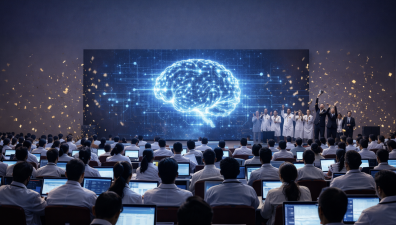
India’s medical education ecosystem marked a digital milestone as the National Board of Examinations in Medical Sciences (NBEMS) secured recognition from Guinness World Records for the most viewers of an Artificial Intelligence in Healthcare lesson live-streamed on YouTube. The achievement reflects the growing integration of digital learning tools in professional medical training and signals India’s push toward AI-enabled healthcare systems.
What Was the Record Achievement?
4
The recognition was awarded for a nationwide online training programme on Artificial Intelligence in Healthcare conducted for registered medical practitioners. The initiative was implemented by the National Board of Examinations in Medical Sciences (NBEMS), an autonomous body under the Union Ministry of Health and Family Welfare.
By attracting the highest number of live viewers for an AI-in-healthcare lesson on YouTube, the programme demonstrated the scale at which India can deliver digital continuing medical education (CME).
NBEMS and Its Expanding Role
NBEMS plays a central role in postgraduate medical education, conducting examinations such as Diplomate of National Board (DNB) and other specialty certifications. Over time, it has transitioned toward competency-based learning models aligned with global standards.
According to NBEMS President Dr. Abhijat Sheth, the Guinness recognition underscores India’s leadership in leveraging digital platforms for medical education and capacity building.
Why AI in Healthcare Matters
Artificial Intelligence is increasingly transforming healthcare delivery across domains:
- AI-assisted radiology and diagnostics.
- Predictive analytics in disease surveillance.
- Clinical decision support systems.
- Drug discovery and personalised medicine.
Training medical practitioners in AI applications ensures that technological adoption is clinically informed and ethically grounded. For a country with vast geographic diversity and doctor–patient imbalances, AI can enhance efficiency and reach.
Digital Public Infrastructure and Health
India’s broader digital health ecosystem — including telemedicine expansion and electronic health records — provides a foundation for AI integration.
The scale of participation in this training programme highlights:
- Growing digital literacy among healthcare professionals.
- Acceptance of online platforms for formal learning.
- Institutional readiness to adopt emerging technologies.
Such initiatives align with India’s aspiration to become a global leader in digital health innovation.
Implications for Medical Education Reform
The milestone also signals a shift in how medical education is delivered:
- From classroom-centric to hybrid and online models.
- From rote-based to competency-driven curricula.
- From static knowledge to technology-integrated practice.
Competency-based training in AI equips practitioners to critically evaluate algorithmic outputs rather than passively rely on them — a crucial safeguard in patient care.
Opportunities and Ethical Considerations
While AI promises efficiency, it raises concerns regarding:
- Data privacy and patient confidentiality.
- Algorithmic bias in clinical decision-making.
- Accountability in AI-driven diagnoses.
Structured training programmes help practitioners navigate these ethical and regulatory dimensions responsibly.
What to Note for Prelims?
- NBEMS is an autonomous body under the Union Health Ministry.
- The record was set for the most viewers of an AI in Healthcare live stream on YouTube.
- AI applications in healthcare include diagnostics, predictive analytics, and decision support.
What to Note for Mains?
- Discuss the role of AI in transforming healthcare delivery in India.
- Examine the significance of digital learning platforms in medical education reform.
- Analyse ethical challenges associated with AI adoption in healthcare.
- Evaluate how digital capacity-building initiatives strengthen public health systems.