Project Mausam is a multi-disciplinary trans-national initiative launched by the Ministry of Culture, Government of India, during the 38th World Heritage Committee session in Doha, Qatar, in June...
The National Mission on Monuments and Antiquities (NMMA) was launched by the Ministry of Culture, Government of India, in March 2007. It was conceived as a time-bound mission...
The Antiquities and Art Treasures Act, 1972 (AATA) was enacted to regulate the internal trade and prevent the smuggling of India’s movable cultural heritage. While the AMASR Act,...
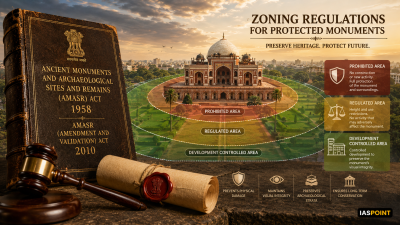
The zoning regulations around centrally protected monuments are primarily governed by the Ancient Monuments and Archaeological Sites and Remains (AMASR) Act, 1958, and were significantly strengthened by the...
The Ancient Monuments and Archaeological Sites and Remains (AMASR) Act, 1958, is the primary legislative framework governing the preservation of India’s historical and archaeological wealth. Enacted under the...
The Ancient Monuments Preservation Act of 1904 was a landmark legislation enacted during the viceroyalty of Lord Curzon. It represented the first systematic attempt by the British colonial...
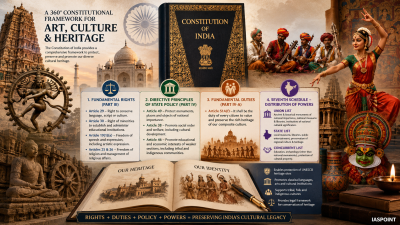
The Constitution of India provides a robust framework for the protection of art, culture, and heritage. These provisions are distributed across Fundamental Rights (Part III), Directive Principles of...
The National Culture Fund (NCF) was established by the Government of India as a Trust under the Charitable Endowments Act, 1890. Launched on November 28, 1996, it serves...
The Indian National Trust for Art and Cultural Heritage (INTACH) is India’s largest non-profit membership organization dedicated to heritage conservation. Founded in 1984 in New Delhi, it was...
The Government of India, through the Ministry of Culture, maintains and funds several autonomous and grantee institutions dedicated to the preservation of Buddhist philosophy, Himalayan cultural heritage, and...