
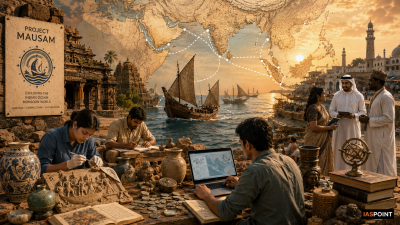
Project Mausam is a multi-disciplinary trans-national initiative launched by the Ministry of Culture, Government of India, during the 38th World Heritage Committee session in Doha, Qatar, in June 2014. The project aims to explore the multi-faceted Indian Ocean “world” (Monsoon World) by collating archaeological and historical research to document the diversity of cultural, commercial, and religious interactions across the Indian Ocean rim.
Core Objectives and Strategic Mandate
The project serves as a cultural tool to re-establish India’s traditional links with its maritime neighbors and provide a counter-narrative to modern geopolitical maritime corridors.
- Trans-national Nominations: To identify and document multifaceted cultural routes and maritime landscapes for nomination as UNESCO World Heritage Sites under the category of Cultural Routes.
- Scientific Research: To understand the impact of monsoon winds on navigation, trade, and the exchange of ideas and religions across the Indian Ocean.
- Archaeological Mapping: To create a comprehensive database of underwater and coastal archaeological sites.
- Revival of Links: To strengthen cultural ties with 39 countries bordering the Indian Ocean, including East Africa, the Arabian Peninsula, the Indian Subcontinent, and Southeast Asia.
Key Implementing Agencies
The project is executed through a collaborative framework involving specialized national and international bodies:
- Nodal Agency: Archaeological Survey of India (ASI).
- Research Support: Indira Gandhi National Centre for the Arts (IGNCA) and National Museum.
- Technical Cooperation: National Institute of Oceanography (NIO), Goa, for underwater archaeology and maritime history.
- Academic Partners: Various international universities and heritage bodies within the Indian Ocean region.
The “Monsoon” Connection: Scientific and Cultural Basis
The term “Mausam” is derived from the Arabic word Mawsim, referring to the season of sailing. The project focuses on how the predictable reversal of monsoon winds enabled ancient mariners to traverse the ocean safely.
- Maritime Trade Routes: Documentation of the “Spice Route” and “Cotton Route” that linked the Malabar and Coromandel coasts to the Roman Empire and the Han Dynasty.
- Cultural Exchange: Studying the spread of Buddhism, Hinduism, and Islam via maritime routes, influencing architecture (e.g., Borobudur in Indonesia) and linguistics.
- Shared Heritage: Identifying commonalities in boat-building traditions, navigational tools like the Kamal, and culinary influences across the littoral states.
Comparison with International Maritime Projects
Project Mausam is often compared to other international heritage and trade initiatives.
| Feature | Project Mausam (India) | Maritime Silk Road (China) |
| Primary Focus | Cultural, Archaeological, and Historical. | Economic, Infrastructure, and Trade. |
| Nature | Soft Power/Heritage-driven. | Geopolitical/Strategic-driven. |
| UNESCO Link | Direct aim for Trans-national Heritage status. | Part of the broader ‘One Belt One Road’ (OBOR). |
| Key Partners | 39 Indian Ocean littoral states. | Global partners across Eurasia and Africa. |
Major Themes for Heritage Documentation
The project categorizes heritage into specific thematic areas to facilitate UNESCO nominations:
Coastal Landscapes and Ports
Documentation of ancient port cities such as Muziris (Kerala), Lothal (Gujarat), Arikamedu (Puducherry), and Tamralipti (West Bengal), along with their counterparts like Zanzibar (Tanzania) and Malacca (Malaysia).
Maritime Cultural Landscapes
This includes lighthouses, coastal forts (e.g., Janjira, Sindhudurg), and underwater shipwrecks that provide evidence of maritime disasters and trade commodities.
Intangible Cultural Heritage (ICH)
Focus on oral traditions of sailors, traditional boat-building techniques (such as the Dhow or Patamar), and the syncretic religious practices evolved in port towns.
Facts and Trivia for UPSC Prelims
- Launch Venue: 38th Session of the World Heritage Committee, 2014.
- Nodal Ministry: Ministry of Culture (not Ministry of External Affairs, though it provides diplomatic support).
- Associated Term: Sailing with the Monsoon – the central theme of the project.
- Participating Nations: Includes countries like Mauritius, Seychelles, Sri Lanka, Thailand, Indonesia, Oman, and Kenya.
- Strategic Significance: Often viewed as India’s “Soft Power” response to China’s Maritime Silk Road, focusing on “Shared History” rather than “Shared Infrastructure.”
- World Heritage Category: It specifically targets the “Cultural Routes” category, similar to the Silk Road heritage sites already recognized by UNESCO.
Progress and Current Status
- International Conferences: India has hosted several international seminars (e.g., in Kochi and Bhubaneswar) to align research methodologies with partner nations.
- Tentative Lists: Efforts are underway to draft “Serial Nominations” for UNESCO, where multiple sites across different countries are linked under a single heritage narrative of the Indian Ocean.
- Digital Archive: The IGNCA is developing a digital repository of maps, manuscripts, and photographs related to Indian Ocean maritime history.