

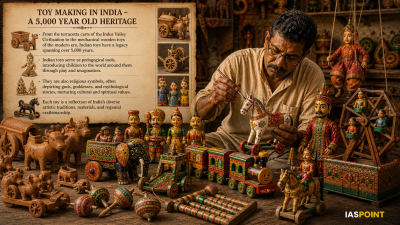
Toy making in India is a heritage that spans over 5,000 years, deeply rooted in the socio-cultural fabric of the country. From the terracotta carts of the Indus Valley Civilization to the mechanical wooden toys of the modern era, Indian toys serve as pedagogical tools, religious symbols, and artistic expressions.
Ancient Foundations
- Indus Valley Civilization (2500–1700 BC): Excavations at Harappa and Mohenjo-Daro revealed sophisticated terracotta toys, including whistles shaped like birds, movable bullock carts, and climbing monkeys. These are among the earliest examples of mechanical toys in human history.
- Literary References: Ancient texts like the Rigveda and the Mahabharata mention toys made of wood and clay. The Sanskrit play Mrichchhakatika (The Little Clay Cart) by Shudraka centers its title on a toy, highlighting its cultural presence.
Medieval and Colonial Shifts
- During the medieval period, toys often took the form of regional deities and folk heroes, used for storytelling and religious festivals.
- The colonial era introduced Western influences, but traditional clusters in Kondapalli, Channapatna, and Varanasi preserved indigenous techniques, using local wood and natural vegetable dyes.
Major Regional Toy Clusters and Styles
India’s toy map is divided into distinct regional specializations based on material availability and local folklore.
Wooden Toy Clusters
- Channapatna Toys (Karnataka): Known as the “Gombegala Ooru” (Toy Town), these toys are made from Ivory Wood (Ale Mara) and polished with lac. They are famous for being non-toxic and organic. (GI Tagged)
- Kondapalli Toys (Andhra Pradesh): Crafted from ‘Tella Poniki’ (softwood), these toys often depict rural life, mythological characters, and the famous “Ambari” (elephant with a carriage). (GI Tagged)
- Eti-Koppaka Toys (Andhra Pradesh): Unique for using lacquer colors derived from seeds, bark, and roots. They are known for their smooth finish and rounded edges. (GI Tagged)
- Varanasi Wooden Toys (Uttar Pradesh): Specializes in lacquerware and hand-painted figures of birds and animals.
Terracotta and Clay Toys
- Asharikandi Toys (Assam): A unique style of terracotta craft where toys like the “Hatima Doll” (mother with child) are made from a specific Hiramati clay.
- Gorakhpur Terracotta (Uttar Pradesh): Famous for the ornate “Terracotta Elephant” and figures of local deities, utilizing a centuries-old firing technique. (GI Tagged)
- Manipur Dolls: Crafted from clay and cloth, these dolls often represent the various tribes and traditional dances (like Ras Leela) of Manipur.
Metal and Cloth Toys
- Dhokra Metal Toys (Odisha/Chhattisgarh): Using the lost-wax casting method, artisans create primitive-style metal figurines of animals and tribal motifs.
- Thanjavur Golu Dolls (Tamil Nadu): While often clay, these include the famous “Thanjavur Thalaiyatti Bommai” (Roly-poly dampener dolls) which use a center-of-gravity principle to stay upright. (GI Tagged)
Comparative Analysis of GI Tagged Toys
| Toy Craft | State | Primary Material | Unique Feature |
| Channapatna Toys | Karnataka | Ivory Wood / Lacquer | Non-toxic vegetable dyes; smooth finish. |
| Kondapalli Bommallu | Andhra Pradesh | Tella Poniki (Soft wood) | Depicts Dasavataram and village life. |
| Nirmal Toys | Telangana | Poniki Wood / Duco paint | Use of ‘Lajward’ (gold color) and herbal extracts. |
| Kathputli | Rajasthan | Wood / Cloth / String | String puppetry used for oral history. |
| Kinhal Toys | Karnataka | Light wood / Paste | Elaborate religious idols and intricate carving. |
| Varanasi Soft Wood | Uttar Pradesh | Gular Wood | Hand-painted religious and animal motifs. |
Technical Processes and Materials
Traditional toy making relies on sustainable, locally sourced materials and indigenous engineering.
Materials Used
- Wood: Ivory wood (Channapatna), Tella Poniki (Kondapalli), Gular/Shisham (Varanasi).
- Dyes: Turmeric (Yellow), Indigo (Blue), Vermilion (Red), and Lac (for glaze).
- Fillers: A mixture of tamarind seed powder and sawdust is often used to provide shape and strength to wooden joints.
Craftsmanship Techniques
- Turning: Used in Channapatna, where wood is rotated on a lathe and shaped with chisels.
- Lacquerware: Applying layers of colored lac while the toy is rotating on a lathe to create a high-gloss, durable finish.
- Pappier-Mâché: Practiced in Kashmir and parts of Odisha to create lightweight masks and figures.
Policy Framework and Economic Significance
The Government of India has recognized the toy industry as a “champion sector” to reduce import dependency and boost exports.
Key Initiatives
- National Action Plan for Toys (NAPT): A multi-ministerial approach to promote traditional Indian toys, involving 14 ministries to improve design, production, and marketing.
- Toycathon: A government-led hackathon aimed at conceptualizing toys based on Indian civilization, history, and mythology.
- Product Quality Control (QC): Mandating ISI certification for toys to ensure safety standards and discourage low-quality imports.
- One District One Product (ODOP): Several toy clusters (e.g., Channapatna, Varanasi) have been identified under the ODOP scheme for targeted development.
Trivia and Facts for UPSC
- Toy Museum of India: The Shankar’s International Dolls Museum in New Delhi houses one of the largest collections of traditional Indian and international dolls.
- Scientific Principles: The Thanjavur Tilting Doll is a classic example of the application of the ‘Center of Gravity’ and ‘Equilibrium’ in traditional Indian crafts.
- Sustainability: Indian traditional toys are almost 100% biodegradable, utilizing wood, clay, natural fibers, and organic dyes, aligning with modern “Green Toys” movements.
- Geographical Concentration: South India (Andhra Pradesh, Karnataka, Tamil Nadu) accounts for the highest number of GI-tagged toy crafts in the country.