
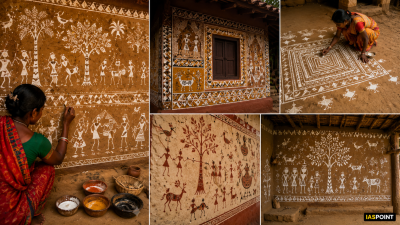
Tribal visual arts in India are characterized by their “functional aesthetics,” where art is not merely decorative but a vital component of ritual, transition, and community identity. Unlike classical Indian art, tribal wall and floor paintings are predominantly ephemeral, created on mud walls or earthen floors using natural pigments, and often destroyed or overwritten during subsequent festivals.
Significant Tribal Wall Art Forms
Wall paintings (Bhitti Chitra) serve as a medium for recording tribal history, appeasing deities, and marking rites of passage.
Warli Painting (Maharashtra)
- Origin: Practiced by the Warli, Malkhar Koli, and Kokna tribes in the North Sahyadri range.
- Technique: Uses a basic graphic vocabulary of a circle (representing the sun/moon), a triangle (mountains/trees), and a square (sacred enclosure).
- Pigments: The background is typically red ochre (Geru) with white paste made from rice flour and water, using gum as a binder.
- Core Theme: The central motif is the Chauk (square), inside which the goddess Palaghat (fertility deity) is depicted. Surrounding scenes showcase the “Circle of Life,” including hunting, dancing (Tarpa dance), and farming.
Saora or Idital Art (Odisha)
- Origin: The Lanjia Saora tribe of Odisha.
- Purpose: These are “spirit paintings” or Iditals meant to appease ancestors and spirits to ensure well-being.
- Visual Style: Highly similar to Warli art but distinct in its focus on the “house” motif. The paintings feature the Italmar (the artist-priest) who dreams the design before painting.
- Themes: Depictions of the afterlife, celestial bodies, and the daily activities of ancestors in the spirit world.
Pithora Paintings (Gujarat and Madhya Pradesh)
- Origin: The Rathwa, Bhilala, and Nayak tribes.
- Religious Significance: Pithora is not just a painting but a ritual performed to seek a boon or thank God Pithora Dev.
- Iconography: The horse is the central motif, representing the gods. A traditional Pithora mural must contain specific elements: the sun, the moon, various animals, and the “Map of the Universe.”
- Artist: Only men, specifically trained Lakhara (painters), perform the ritualistic painting.
Sohrai and Khovar Art (Jharkhand)
- Sohrai: A harvest art practiced by women of tribes like the Santhal and Munda. It is characterized by multi-colored mud murals celebrating fertility and livestock.
- Khovar: A matrimonial art form (combining Kho or cave and Var or groom) practiced during the wedding season.
- Technique: The “comb-cut” technique involves applying a layer of dark earth followed by a layer of light-colored kaolin, then scraping designs using combs or fingers while wet.
- Recognition: Both Sohrai and Khovar received the Geographical Indication (GI) tag in 2020.
Tribal Floor Arts and Geometric Symbolism
Floor paintings are usually ritualistic welcomes to deities and are characterized by high levels of geometric precision.
- Mandana (Rajasthan/MP): Practiced by the Meena tribe. These involve chalk-white drawings on red clay-plastered floors. Motifs include the Chauk (square) and various floral patterns like Peacock and Swastik.
- Aipan (Uttarakhand): While practiced across Kumaon, it has deep roots in the tribal and folk traditions of the region. It uses a red background (Biswar) and white rice paste to create linear and tantric patterns.
- Aripan (Bihar): Practiced by tribal and semi-tribal communities in Mithila, utilizing fingers to create patterns that represent the cosmic order.
Comparative Matrix of Tribal Art Forms
| Art Form | Region | Primary Tribe | Medium/Colors | Distinctive Feature |
| Warli | Maharashtra | Warli, Koli | White (Rice) on Red | Geometric stick figures; focus on Mother Nature. |
| Pithora | Gujarat/MP | Rathwa, Bhilala | Multi-color natural dyes | Horse motifs; ritualistic “vow” fulfillment. |
| Idital | Odisha | Lanjia Saora | White on Red Ochre | Rectangular frames; ancestor worship focus. |
| Sohrai | Jharkhand | Santhal, Munda | Natural earth colors | Multi-layered mud art; harvest themes. |
| Paitkar | Jharkhand | Santhal | Scrolls/Watercolors | Often called “Scroll Painting” of the East. |
Pigments and Tools: The Indigenous Chemistry
Tribal artists rely exclusively on “Forest Chemistry” for their palette, ensuring ecological sustainability.
- White: Derived from rice paste or kaolin (white clay).
- Black: Obtained from soot (lampblack) or powdered charcoal.
- Red/Brown: Sourced from hematite, red oxide, or burnt soil (Geru).
- Yellow: Derived from turmeric or specific yellow stones/clays.
- Brushes: Made from chewed twigs of Neem or Babul, or bundles of local grass.
Fact Sheet for UPSC Prelims
- The Concept of ‘Chauk’: Most tribal wall arts (Warli, Saora, Meena) revolve around the ‘Chauk’ or square, which symbolizes the ordered, civilized world vs. the chaotic forest.
- Bhil Art: Distinctive for its “dotted” technique. Every pattern is composed of dots, where each dot represents an ancestor or a prayer. Lado Bai and Bhuri Bai are prominent contemporary Bhil artists.
- Gond Art (Madhya Pradesh): Known for its “dots and lines” technique to create a sense of movement. Jangarh Singh Shyam was the pioneer who brought this wall art to paper/canvas.
- Kurumba Art (Tamil Nadu): A rare ritual art of the Kurumba tribe (Nilgiris) using resins and crushed leaves, depicting the hills and local flora.
- Paitkar Paintings: Considered one of the oldest forms of tribal scroll painting in India, traditionally used by wandering storytellers in Jharkhand.