
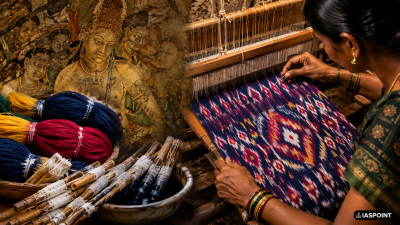
Ikat, derived from the Malay-Indonesian word mangikat (meaning to tie or bind), is an ancient resist-dyeing technique where the patterns are created by dyeing the yarns before they are woven into fabric. In India, this tradition dates back centuries, with visual evidence found in the 7th-century frescoes of the Ajanta Caves. Unlike block printing or embroidery, where the design is applied to the finished cloth, Ikat requires rigorous mathematical calculation to ensure the dyed segments of the yarn align perfectly on the loom to form the intended motif.
Classification of Ikat Techniques
Indian Ikat is categorized based on whether the warp, the weft, or both are dyed to create the pattern.
- Single Ikat: Only one set of yarns—either the warp (longitudinal) or the weft (transverse)—is tie-dyed. The other set is usually a solid color.
- Double Ikat: Both the warp and the weft yarns are tie-dyed with such precision that they intersect to form a complete pattern on the loom. This is one of the most difficult textile arts globally.
Major Regional Ikat Traditions in India
1. Patan Patola (Gujarat)
Patan Patola is the pinnacle of Double Ikat weaving in India. Historically patronized by the Solanki Rajputs, these saris were once considered symbols of ultimate royalty and were traded as far as Indonesia.
- Material: High-quality mulberry silk.
- Distinction: It is a “Double Ikat” tradition where the fabric is reversible; the color and intensity are identical on both sides.
- Motifs: Pan Bhat (Peepal leaf), Ratan Chok (Jewel square), Nari Kunjar (Woman and Elephant), and Vagh-Kunjar (Tiger and Elephant).
- Fact: A single Patola sari can take 6 months to a year to complete due to the complex dyeing process.
2. Pochampally Ikat (Telangana)
Located in the Bhoodan Pochampally region near Hyderabad, this craft is often referred to as “Silk City.” It was the first traditional craft in India to receive a Geographical Indication (GI) status in 2004.
- Technique: Primarily Single Ikat, though Double Ikat is also produced.
- Characteristics: Known for geometric patterns and a smoother finish compared to Odisha Ikat. The designs are modern, often featuring large diamonds and grids.
- Telia Rumal: A specific sub-tradition involving the use of oil (Tel) to treat the yarn, making it water-repellent and soft. Historically used as turbans or loongis in West Asia.
3. Odisha Ikat (Bandha Art)
Known locally as Bandha, Odisha’s Ikat is distinguished by its curvilinear patterns and the use of the “Tussar” silk variety.
- Sambalpuri Bandha: Features the Shankha (shell), Chakra (wheel), and Phula (flower). It utilizes a “tie and dye” method on the weft.
- Nuapatna (Khandua): These are ceremonial silks offered to Lord Jagannath at Puri, often containing verses from the Gita Govinda woven into the fabric.
- Pasapali: Named after the Pasa (chessboard), characterized by check patterns.
4. Puttapaka Ikat (Telangana)
A variant of the Pochampally tradition, Puttapaka is known for the “Puttapaka Telia Rumal,” which uses a laborious natural dyeing process involving gingerly oil, sheep dung, and castor seed oil to achieve deep reds and blacks.
Comparative Analysis of Indian Ikat Clusters
| Feature | Patola (Gujarat) | Pochampally (Telangana) | Sambalpuri (Odisha) |
| Ikat Type | Double Ikat | Single & Double Ikat | Single Ikat (mostly weft) |
| Material | Mulberry Silk | Silk and Cotton | Tussar/Mulberry Silk & Cotton |
| Motifs | Geometric & Stylized Flora | Sharp Geometrics/Grids | Curvilinear, Nature, Fish |
| Texture | Very Smooth, Stiff | Soft, High Luster | Textured, Earthy |
| GI Status | Yes (Patan Patola) | Yes | Yes |
Technical Process: The Journey from Yarn to Fabric
- Design Plotting: The weaver calculates the design on graph paper to determine where the ties (resists) must be placed on the yarn.
- Tying (Binding): Bundles of yarn are tied tightly with rubber bands or threads to prevent dye penetration in specific areas.
- Dyeing: The yarn is dipped in dye baths. For multi-colored patterns, this tying and dyeing process is repeated multiple times.
- Loom Setting: The dyed warp is stretched on the loom. In Double Ikat, the dyed weft must then be adjusted manually with every pass of the shuttle to match the warp pattern.
- Weaving: The rhythmic interlacing of the dyed yarns reveals the “blurry” or “hazy” edges that are the aesthetic signature of authentic Ikat.
UPSC Prelims Fact Sheet and Trivia
- The “Blurry” Look: The slight haziness at the edges of Ikat motifs is a mark of authenticity, caused by the extreme difficulty the weaver faces in aligning the dyed yarns.
- Geographical Indication (GI): Odisha Ikat, Patan Patola, Pochampally Ikat, and Puttapaka Telia Rumal all hold individual GI tags.
- Indo-Indonesian Connection: The similarity between Indian Patola and Indonesian Ikat suggests a vibrant maritime trade history; Patola fabrics were historically used as currency in the spice trade.
- Cultural Significance: In many Indian communities, Ikat is considered “shubh” (auspicious). The Khandua Pata of Odisha is an essential part of the temple rituals for the deities of Puri.
- Sustainable Dyeing: Traditional Ikat centers like Puttapaka still utilize vegetable dyes derived from madder root (red), pomegranate rind (yellow), and indigo (blue).