
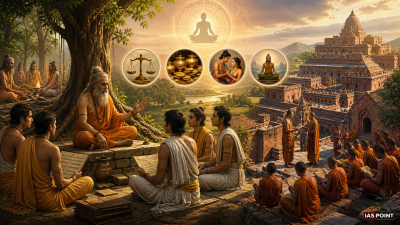
The education system in ancient India was a holistic process aimed at the manifestation of the divine perfection already existing in man. It transitioned from the oral traditions of the Vedic period to the structured institutional frameworks of the later Buddhist era. The primary goal was not merely the acquisition of facts but the attainment of Moksha (liberation) and the fulfillment of Purusharthas (Dharma, Artha, Kama, and Moksha).
Core Philosophical Foundations
The pedagogical approach was deeply rooted in various schools of Indian philosophy.
- Vedic Philosophy: Focused on the sanctity of the Vedas and the performance of Yajnas. It emphasized the relationship between the Atman (Soul) and Brahman (Universal Soul).
- Upanishadic Philosophy: Introduced the concept of Jnana (knowledge) as a path to liberation, shifting focus from rituals to internal meditation and inquiry.
- Buddhist and Jain Philosophies: Challenged the Vedic monopoly, promoting education in Prakrit and Pali to make it accessible to the masses and focusing on ethical conduct and logic.
Stages and Rituals of Education
Education was marked by specific formal ceremonies that initiated a student into the world of learning.
| Ritual | Significance |
| Vidyarambha | Performed at age 5; initiation into the world of alphabets and basic numeracy. |
| Upanayana | The “Sacred Thread” ceremony; marked the beginning of formal Vedic education under a Guru. |
| Savitri Vrata | A specific ritual for students dedicated to the Goddess of Learning. |
| Samavartana | The convocation ceremony performed at the end of the student life (Brahmacharya phase). |
Methods of Learning and Pedagogy
The transmission of knowledge was primarily oral, utilizing the Shruti (that which is heard) and Smriti (that which is remembered) traditions.
Three-Step Learning Process
- Shravana: Listening to the truths uttered by the teacher.
- Manana: Deliberation and reflection on what was heard to assimilate the meaning.
- Nididhyasana: Constant meditation and application of the truth in daily life.
Teaching Techniques
- Rote Memorization: Used to preserve the precise phonetics of Vedic hymns.
- Anvikshiki (Logic): Critical inquiry used in debating philosophical points.
- Catechetical Method: A system of questions and answers between the pupil and the teacher.
- Prashna-Uttara: Formal debating sessions often held in royal courts or assemblies (Parishads).
Key Educational Institutions
Ancient India hosted various types of learning centers catering to different levels of expertise and subjects.
- Gurukuls: Residential centers where students lived with the Guru as part of a family.
- Parishads: Assemblies of older and more learned scholars where discussions on complex legal and philosophical issues took place.
- Tols: Centers dedicated specifically to Sanskrit learning.
- Ghatikas: Educational institutions attached to temples, primarily found in South India (e.g., Kanchi).
- Agraharas: Settlement of Brahmins provided with land grants to pursue and teach Vedic knowledge.
Premier Ancient Universities (Mahaviharas)
During the 5th to 12th centuries CE, India became a global hub for higher education, attracting scholars from China, Tibet, Korea, and Central Asia.
| University | Location | Notable Features |
| Taxila (Takshashila) | Near Rawalpindi (Pakistan) | Known for medicine (Ayurveda) and political science. Chanakya and Panini were associated with it. |
| Nalanda | Bihar | Founded by Kumaragupta I; specialized in Mahayana Buddhism. Its library was called Dharmaganja. |
| Vikramshila | Bihar | Established by King Dharmapala of the Pala dynasty; specialized in Vajrayana Buddhism (Tantra). |
| Valabhi | Gujarat | A center for Hinayana Buddhism and secular subjects like Law and Economics. |
| Odantapuri | Bihar | Established by the Pala King Gopala; served as a model for Tibetan monasteries. |
| Jagaddala | Bengal | A late Pala period center known for Sanskrit poetry and Buddhist translations. |
Subjects of Study: Para and Apara Vidya
Ancient curriculum was divided into two broad categories: Para Vidya (Higher/Spiritual knowledge) and Apara Vidya (Lower/Temporal knowledge).
- Vedangas: Six auxiliary disciplines of the Vedas—Shiksha (Phonetics), Kalpa (Ritual Canon), Vyakarana (Grammar), Nirukta (Etymology), Chhanda (Meter), and Jyotisha (Astronomy).
- Shilpasastras: Manuals on arts and crafts including architecture, sculpture, and painting.
- Ayurveda: The science of life and medicine (Sushruta and Charaka).
- Dhanurveda: Military science and archery.
- Gandharvaveda: The science of music and dance.
- Artha-Shastra: Political science and administration.
Role and Status of Women in Education
In the early Vedic period, women had access to education and were classified into two groups:
- Sadyodvahas: Women who pursued education until they married.
- Brahmavadinis: Women who opted for a life of lifelong study and philosophy.
- Notable Female Scholars: Gargi (who challenged Yajnavalkya), Maitreyi, Lopamudra, and Ghosha.
Trivia and Key Facts for Prelims
- The Library of Nalanda: Consisted of three buildings: Ratnasagara, Ratnodadhi, and Ratnaranjaka.
- UNESCO Recognition: Taxila was declared a World Heritage Site in 1980.
- Jataka Tales: Provide significant insights into the student life and curriculum of the Buddhist period.
- The Chinese Travelers: Xuanzang (Hiuen Tsang) and Yi Jing (I-Tsing) provided detailed accounts of the discipline and curriculum at Nalanda and Valabhi.
- Medium of Instruction: While Sanskrit was the primary language of the elite and Vedic schools, Pali and Prakrit were extensively used in Buddhist and Jain monasteries respectively.