
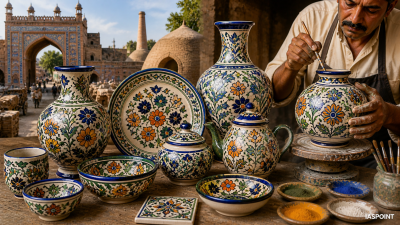
Khurja Pottery, often referred to as the “Ceramic City of India,” is a centuries-old glazed pottery tradition located in the Bulandshahr district of Uttar Pradesh. It is one of the oldest centers for glazed pottery in the subcontinent, tracing its origins back to the 14th century. Unlike the “no-clay” blue pottery of Jaipur, Khurja pottery is clay-based and renowned for its vibrant colors, durability, and intricate hand-painted floral motifs. It was granted the Geographical Indication (GI) Tag in 2015.
Historical Genesis and Evolution
The history of Khurja pottery is inextricably linked to the military expeditions of Central Asian rulers.
- Timurid Influence: Legend suggests that the craft began when potters accompanying the army of Timur (Tamerlane) settled in the region over 600 years ago. These artisans brought with them the Persian knowledge of glazing and floral art.
- Mughal Patronage: The craft received a significant boost during the Mughal Empire, as the proximity to Delhi and Agra allowed potters to supply glazed tiles and vessels for royal architectural projects and households.
- Post-Independence Shift: After 1947, the Government of Uttar Pradesh established a pottery development center, shifting the focus from individual artisan workshops to a more organized industrial cluster that now exports worldwide.
Material Composition and Manufacturing Process
Khurja pottery utilizes a specific blend of raw materials to achieve its characteristic strength and glassy finish.
- The Clay Mix: A blend of China Clay (Kaolin), Ball Clay, Quartz, and Feldspar. This mixture allows the pottery to withstand high firing temperatures without deforming.
- Forming: Articles are created using three primary methods: throwing on the potter’s wheel, Jigger-Jolly (a mechanical process for symmetrical shapes), and slip-casting in plaster molds for complex designs.
- Painting: Once the body (biscuit) is dry, it is painted by hand. The most traditional style involves “underglaze painting,” where the design is applied before the glaze is added.
- Firing: The articles are fired in kilns at temperatures ranging between 1180°C and 1250°C. This high-temperature firing ensures that the glaze fuses perfectly with the clay, making the products “stone-ware” quality—non-porous and microwave-safe.
Distinctive Artistic Features and Motifs
The aesthetic appeal of Khurja pottery lies in its use of “warm” backgrounds and traditional Persian-influenced patterns.
- Color Palette: Traditionally, the background is an off-white or cream color, with motifs painted in cobalt blue, copper green, and occasionally manganese violet.
- Patterns: The most common motif is the floral vine or Bel-Buti. These are often repetitive, symmetrical patterns that cover the entire surface of the vessel.
- The Glaze: A thick, transparent glaze is applied over the painting, which gives the finished product a deep, lustrous shine and protects the colors from fading over time.
Comparison: Khurja vs. Jaipur Blue Pottery
| Feature | Khurja Pottery | Jaipur Blue Pottery |
| Primary Base | Clay-based (China Clay/Kaolin) | No-clay (Quartz powder/Glass) |
| Manufacturing | Wheel, Casting, and Jigger-Jolly | Exclusively Molded |
| Durability | High; sturdy and thick-walled | Fragile; brittle and lightweight |
| Firing Temp | High (1180°C – 1250°C) | Low (800°C – 850°C) |
| Utility | Suitable for cooking/heavy storage | Primarily decorative/serving ware |
| GI Status | Uttar Pradesh (2015) | Rajasthan (2008) |
Socio-Economic and Archaeological Importance
- Industrial Hub: Today, Khurja hosts over 400 specialized units and provides employment to thousands of artisans. It is a major foreign exchange earner for the Indian handicraft sector.
- Urban Continuity: Unlike many ancient pottery styles that died out (like NBPW), Khurja represents a “living tradition” that has adapted medieval Persian techniques to modern commercial demands.
- Scientific Advancement: The Central Glass and Ceramic Research Institute (CGCRI) has a center in Khurja to provide technical support, helping potters improve kiln efficiency and glaze quality.
Fact Sheet for UPSC Aspirants
- GI Tag: Khurja Pottery is protected under the Geographical Indications of Goods (Registration and Protection) Act, 1999.
- Pottery Type: It is classified as Stoneware, which is more durable than Earthenware (Terracotta) but less translucent than Porcelain.
- Lead-Free Transition: In recent years, there has been a significant push toward using lead-free glazes to meet international safety standards for food-grade ceramics.
- Trivia: Khurja is often nicknamed “The Golden City of Ceramics” due to the immense economic value generated by its kilns.
- Cultural Blend: While the technique is Persian, the motifs often incorporate Indian flora, representing the Ganga-Jamuni Tehzeeb (composite culture) of Uttar Pradesh.