
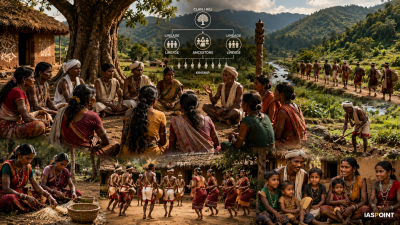
Tribal societies in India, often referred to as Adivasis, are characterized by a social structure that differs significantly from the caste-based hierarchy of mainstream Indian society. Their organization is primarily based on kinship, egalitarianism, and a deep-seated connection to a specific territory. While the caste system is based on ritual purity and pollution, tribal structures are governed by lineage and clan identity.
Key Elements of Tribal Social Stratification
Unlike the vertical hierarchy of the Varna system, tribal societies are generally horizontal or segmentary. However, specific internal structures define their social life:
- Clan (Sect): The most basic unit of social organization. Clans are usually totemic and exogamous, meaning members must marry outside their own clan.
- Lineage: A group of families who can trace their descent from a common known ancestor.
- Phratry: A grouping of several clans. For example, the Gond tribe is divided into four phratries based on the number of gods they worship (e.g., the four-god, five-god, six-god, and seven-god clans).
- Moiety: In some tribes, the entire society is divided into two distinct halves or “moieties.” A person born into one moiety must marry someone from the other.
Marriage Customs and Kinship Patterns
Marriage in tribal India is viewed as a social contract rather than a religious sacrament. This leads to a variety of unique marriage practices and high levels of social autonomy for women compared to traditional rural societies.
Unique Forms of Tribal Marriage
| Marriage Type | Description | Representative Tribes |
| Marriage by Capture | Known as Posiothur, where the groom “captures” the bride with her tacit consent. | Ho, Santhal, Bhil, Gond |
| Marriage by Service | The groom lives with the bride’s family and works for them for a specific period before marriage. | Gond (Lamsena), Birhor |
| Marriage by Purchase | Involves the payment of ‘Bride Price’ (Pon or Dapa) to the bride’s father. | Santhal, Oraon, Bhil |
| Marriage by Elopement | Couples run away to marry when families do not agree. | Bhil, Juang |
| Marriage by Intrusion | A woman forcibly enters the man’s house and refuses to leave until accepted. | Birhor, Ho |
| Marriage by Trial | A man proves his bravery or skill to win a bride. | Bhil (Gol Gadhero) |
Matrilineal and Patrilineal Systems
- Matrilineal Structure: Descent and inheritance are traced through the mother. The Khasi, Jaintia, and Garo tribes of Meghalaya are the most prominent examples. In these societies, the youngest daughter (Khadduh among Khasis) often inherits the ancestral property.
- Patrilineal Structure: The majority of Indian tribes (Gond, Santhal, Bhil) follow patrilineal descent where the father is the head of the family and property passes to sons.
Youth Dormitories: The Centers of Socialization
Youth dormitories are a unique feature of tribal social structures, serving as educational and cultural centers where the younger generation learns tribal lore, music, dance, and social responsibilities.
- Ghotul (Gond/Muria): Perhaps the most famous dormitory system where boys (Cheliks) and girls (Motiaris) learn social discipline and artistic skills.
- Dhumkuria (Oraon): A strictly disciplined institution for boys where they are trained in hunting and agriculture.
- Morung (Nagas): Elaborately decorated wooden structures that serve as the nerve center of Naga village life and defense.
- Giti-Ora (Munda/Ho): A simpler version of the youth dormitory found in the Chota Nagpur region.
Tribal Political and Judicial Systems
Traditional tribal governance is characterized by the “Village Council,” which functions on the basis of consensus rather than majority rule.
- The Village Headman: Known as Manjhi (Santhal), Patel (Bhil), or Gaon Burha (Naga), he is the secular head responsible for maintaining order and collecting revenue.
- The Religious Head: Known as Pahan (Munda/Oraon) or Deori, he handles all spiritual matters and ensures the gods are appeased.
- Parha Panchayat: A higher-level council that governs a cluster of villages (common among the Oraon and Munda). It acts as a court of appeal for inter-village disputes.
Status of Women in Tribal Society
While not perfectly egalitarian, tribal women generally enjoy higher social status and mobility than their counterparts in caste-based societies.
- Economic Participation: Women are primary contributors to the economy through forest produce collection and agriculture.
- Right to Divorce: Divorce and remarriage (Natara among Bhils) are socially accepted and relatively easy to obtain for both genders.
- Decision Making: In matrilineal tribes, women hold the keys to economic resources, though formal political power often remains with the men (maternal uncles).
Tribal Social Trivia for UPSC Prelims
- Polyandry in India: The Toda (Nilgiris) and the Jaunsari (Uttarakhand) are known for practicing fraternal polyandry (one woman marrying multiple brothers).
- The Concept of ‘Dapa’: In Western India, the high cost of ‘Bride Price’ (Dapa) among Bhils has led to social movements aiming to reform and reduce these payments.
- Naga Village Gates: Naga social structure is so territorially defined that each village is often a self-contained “republic” with its own fortified gates.
- The ‘Bithlaha’ Punishment: A rare and extreme form of social boycott among Santhals used as a punishment for violating major social taboos (like endogamy).