
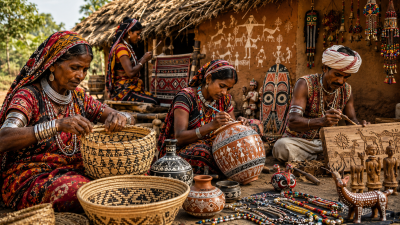
Tribal handicrafts in India are not merely artistic products but are deeply intertwined with the spiritual, social, and economic lives of over 700 scheduled tribes. These crafts are characterized by the use of locally available natural resources, indigenous motifs, and ancient techniques passed down through oral traditions. Unlike urban crafts, tribal art is often communal and functional, reflecting a harmonious relationship with nature.
Metal Craft: The Lost Wax Tradition
Tribal metalwork in India primarily utilizes the Cire Perdue or “Lost Wax” casting technique, which dates back to the Indus Valley Civilization.
- Dhokra Art (Chhattisgarh, Odisha, West Bengal): Practiced by the Gadwa and Jharia tribes. It involves creating a clay core, coating it with wax, and replacing the wax with molten brass or bell metal.
- Fact: No two Dhokra pieces are identical because the mold must be broken to retrieve the object.
- Bastariya Iron Craft (Chhattisgarh): The Lohar community of Bastar creates decorative items from recycled scrap iron. Unlike Dhokra, this involves beating metal into shape while hot.
- Bell Metal Craft of Kerala: The Aranmula Kannadi (metal mirror) is a unique metallurgical marvel from the tribal-influenced traditions of Pathanamthitta.
Tribal Textiles and Embroidery
Textiles serve as a visual marker of tribal identity, with specific patterns identifying the weaver’s clan or social status.
- Toda Embroidery (Tamil Nadu): Locally known as Pukhoor, this is practiced by the Toda tribe of the Nilgiris. It uses red and black threads on a white background to create geometric patterns that resemble weaving. (GI Tagged).
- Lambani/Banjara Embroidery (Karnataka/Telangana): Characterized by vibrant colors, mirror work (Abhla), and shells. It reflects the nomadic heritage of the Banjara community.
- Kotpad Handloom (Odisha): A vegetable-dyed fabric woven by the Mirgan community for the local tribes. It uses the root of the Aal (Indian Mulberry) tree for its distinct maroon hue. (GI Tagged).
- Naga Shawls: Every Naga tribe (Angami, Ao, Chakhesang, etc.) has a unique shawl pattern. The “Chakhesang Shawl” is a GI-protected product.
Tribal Paintings and Wall Art
Tribal paintings are traditionally ritualistic, often painted on the walls of huts to mark festivals, births, or harvests.
- Warli Painting (Maharashtra): Practiced by the Warli tribe in the Sahyadri Range. It uses basic geometric shapes (circle, triangle, square) to represent elements of nature. The white pigment is a mixture of rice paste and water with gum.
- Gond Art (Madhya Pradesh): Created by the Gond tribe, these paintings are famous for the use of dots and lines to create a sense of movement. They often depict “Prakriti” (Nature) and the “Tree of Life.”
- Pithora Paintings (Gujarat/Madhya Pradesh): A ritualistic wall painting practiced by the Rathwa and Bhilala tribes. It is more of a prayer than an art form, centered around the God of Food Grains.
- Saura Art (Odisha): Similar to Warli but visually distinct, these “Ikon” paintings represent the everyday life of the Saura tribe.
Regional Specializations in Tribal Handicrafts
| Craft Name | Primary Tribe | Region | Key Feature |
| Dokra | Gadwa / Jharia | Chhattisgarh/Odisha | Lost-wax bell metal casting. |
| Wrought Iron | Lohar | Bastar, Chhattisgarh | Beaten iron animal and bird motifs. |
| Batik Print | Various | Madhya Pradesh | Wax-resist dyeing on tribal fabrics. |
| Mask Making | Gond / Rajbanshi | MP / West Bengal | Used in Gomira and Chhau dances. |
| Pukhoor | Toda | Nilgiris, TN | Reversible geometric embroidery. |
| Beadwork | Naga tribes | Nagaland | Symbolic status markers in jewelry. |
| Paitkar Painting | Santhal | Jharkhand/WB | Scroll paintings on forest-based life. |
Bamboo and Cane Work in Tribal Life
For many tribes, especially in Central India and the Northeast, bamboo is the “Cradle to Grave” companion.
- Basketry of the North East: Tribes like the Adi, Mishmi (Arunachal), and Konyak (Nagaland) create highly specialized baskets for foraging, storage, and carrying infants.
- Kauna Reed Craft (Manipur): The Meitei and local tribal communities use the water reed to make biodegradable mats and bags.
- Tribal Jewelry: Use of “Pachchi” (glass), seeds, feathers, and coins. The “Hasli” (stiff neck ring) is a common tribal ornament across Central India.
Statutory Bodies and Government Initiatives
The promotion of tribal handicrafts is a key component of India’s “Vocal for Local” and tribal empowerment schemes.
- TRIFED (Tribal Cooperative Marketing Development Federation of India): Established in 1987 under the Ministry of Tribal Affairs. It manages the Tribes India retail outlets.
- Van Dhan Vikas Kendra: Aims at value addition for Minor Forest Produce (MFP) and tribal handicrafts.
- TRIBES India E-Mart: A digital platform to connect tribal artisans directly with global markets.
- Pradhan Mantri Janjati Adivasi Nyaya Maha Abhiyan (PM-JANMAN): A recent initiative focusing on the holistic development of Particularly Vulnerable Tribal Groups (PVTGs), including their traditional crafts.
Facts and Trivia for UPSC Prelims
- GI Tagged Tribal Arts: The Sohrai-Khovar paintings of Jharkhand and the Idu Mishmi textiles of Arunachal Pradesh are recent additions to the GI registry.
- The Concept of ‘Ghotul’: In Muria tribal culture, the Ghotul (youth dormitory) serves as a training ground where traditional crafts, music, and dance are passed to the younger generation.
- Eco-friendly Dyes: Tribal crafts predominantly use “Myrobalan” (Harad), Indigo, Madder, and Pomegranate rinds for coloring, making them 100% sustainable.
- The Significance of the Horse: In many tribal crafts (like Pithora and Dhokra), the horse is a recurring motif symbolizing the speed of the wind and the carrier of the soul to the ancestors.