
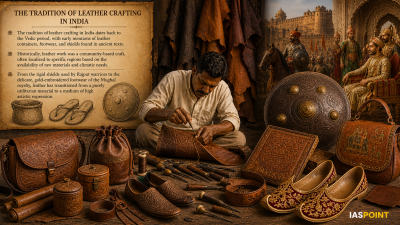
The tradition of leather crafting in India dates back to the Vedic period, with early mentions of leather containers, footwear, and shields found in ancient texts. Historically, leather work was a community-based craft, often localized to specific regions based on the availability of raw materials and climatic needs. From the rigid shields used by Rajput warriors to the delicate, gold-embroidered footwear of the Mughal royalty, leather has transitioned from a purely utilitarian material to a medium of high artistic expression.
Major Regional Clusters and Specialized Leather Arts
India’s leather handicraft sector is geographically diverse, with each region offering a distinct style influenced by local culture and available tanning techniques.
Kolhapuri Chappals of Maharashtra and Karnataka
Kolhapuri chappals are handcrafted leather footwear tanned using vegetable dyes. They received the Geographical Indication (GI) tag in 2019, shared between four districts in Maharashtra (Kolhapur, Sangli, Satara, and Solapur) and four in Karnataka (Belagavi, Bagalkot, Dharwad, and Kalaburagi).
- Unique Feature: These are completely glueless, held together by leather stitching and “ear” like flaps on the sides.
- Material: Hard leather made from buffalo hide is typically used for the sole, while goat or calf skin is used for the upper straps.
Mojari and Juti of Rajasthan and Punjab
Traditional footwear known as Mojaris or Jutis are synonymous with the vibrant culture of North and Northwest India.
- Rajasthan (Jaipur and Jodhpur): Features “Kashida” embroidery where leather is decorated with silk, cotton, or gold/silver (Zari) threads. The leather is often treated to be extremely soft.
- Punjab (Muktsar and Fazilka): Known for robust Jutis with heavy embroidery and “tilla” work (metallic wire).
Shantiniketan Leather Goods of West Bengal
Originating in the 1940s under the influence of Rabindranath Tagore’s Visva-Bharati University, this craft utilizes the “E.I.” (East India) tanning process.
- Process: Goat skins are tanned with vegetable extracts and then hand-painted or embossed with batik-style motifs.
- Aesthetics: The designs usually depict tribal art, floral patterns, and scenes from rural Bengal. It holds a GI tag.
Leather Puppetry (Tholu Bommalata and Togalu Gombeyaata)
Shadow puppetry is a unique intersection of leather craft and performing arts in South India.
- Andhra Pradesh: Tholu Bommalata puppets are made from translucent goat skin, intricately perforated and painted with natural dyes.
- Karnataka: Togalu Gombeyaata uses smaller leather puppets to narrate stories from the Ramayana and Mahabharata.
Comparative Overview of Leather Craft Centers
| Craft Name | Primary Region | Distinguishing Feature | Material/Technique |
| Kolhapuri Chappal | Maharashtra/Karnataka | Glueless, hand-stitched, GI protected | Vegetable-tanned buffalo/goat skin |
| Shantiniketan Leather | West Bengal | Batik work and floral embossing | Goat skin, vegetable tanning |
| Mojari/Juti | Rajasthan/Punjab | Intricate Zari and Silk embroidery | Softened camel or cow hide |
| Leather Puppetry | AP/Karnataka/TN | Translucent, articulated shadow puppets | Perforated and painted goat skin |
| Bikaner Camel Leather | Rajasthan | Usta Art (embossed gold painting) | Treated camel hide |
| Kashmiri Leather | Jammu & Kashmir | Embroidery similar to Pashmina shawls | Suede and soft sheep leather |
Technical Aspects and Traditional Tanning Processes
Traditional Indian leather craft relies heavily on eco-friendly processes that distinguish it from industrial leather production.
Vegetable Tanning (Bag-Tanning)
In rural clusters like those in Rajasthan and Madhya Pradesh, “Bag-Tanning” is common. Hides are sewn into a bag shape and filled with a solution of crushed babul (Acacia nilotica) bark and water. This natural process takes several days but results in durable, breathable leather.
Decorative Techniques
- Embossing: Pressing a metal die onto damp leather to create a raised relief.
- Appliqué: Sewing pieces of colored leather onto a base leather sheet to form patterns.
- Punching: Creating geometric holes in the leather, often seen in footwear to allow ventilation.
Institutional Support and Government Initiatives
The Indian leather industry is one of the top foreign exchange earners and is supported by several specialized bodies.
- Council for Leather Exports (CLE): An autonomous organization under the Ministry of Commerce and Industry for export promotion.
- Central Leather Research Institute (CLRI): Located in Chennai, it is the world’s largest leather research institute under the CSIR.
- IDLS Scheme: The Integrated Development of Leather Sector (IDLS) scheme provides financial assistance for modernization and technology up-gradation.
- GI Protection: Government efforts have secured GI tags for Kolhapuri Chappals and Shantiniketan Leather to prevent the sale of cheap synthetic imitations.
Facts and Trivia for UPSC Aspirants
- The Leather City of the World: Kanpur, Uttar Pradesh, is often referred to as the “Leather City” due to its massive concentration of tanneries and footwear units.
- The “Kachchh” Leather Craft: In Gujarat, the Meghwal community practices a unique form of leather craft where the leather is decorated with “Jari” (silver thread) and “Tiki” (mirror work), mirroring the local textile traditions.
- Eco-friendly Transition: India is the second-largest producer and consumer of footwear in the world, with a growing shift from chrome tanning to vegetable tanning in the handicraft sector to meet international environmental standards.
- Export Significance: India accounts for approximately 13% of the world’s leather production of hides/skins, with leather handicrafts forming a significant portion of the luxury boutique export market.