
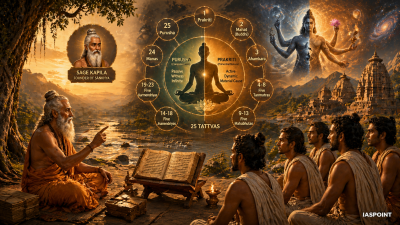
Samkhya is recognized as the oldest of the six orthodox (Astika) schools of Indian philosophy. Traditionally attributed to Sage Kapila, who authored the Samkhya Sutra, the school is fundamentally dualistic and served as the metaphysical foundation for the later Yoga school of Patanjali. The term “Samkhya” is derived from the Sanskrit word Sankhya (number or calculation), reflecting its systematic enumeration of the principles of existence.
The Dualistic Metaphysics: Purusha and Prakriti
The core of Samkhya philosophy lies in its dualistic theory, which posits that the universe is composed of two independent and eternal realities.
- Purusha (The Self/Consciousness):
- It is pure, eternal consciousness that is unchangeable and devoid of qualities.
- It is the “Silent Witness” (Sakshi) that does not act but is the source of awareness.
- Samkhya asserts the plurality of Purushas (Purusha-bahutva), meaning every living being has an individual soul.
- Prakriti (Primordial Matter/Nature):
- It is the unconscious, material cause of the universe.
- Prakriti is active and ever-changing but requires the presence of Purusha to begin the process of evolution.
- It is the state of equilibrium of the three Gunas.
The Three Gunas (Attributes of Nature)
Prakriti is composed of three constituent forces known as Gunas. The interaction and imbalance of these Gunas drive the creation of the material world.
| Guna | Characteristics | Associated Color/Symbol |
| Sattva | Purity, lightness, illumination, and joy. | White |
| Rajas | Activity, passion, motion, and pain. | Red |
| Tamas | Inertia, darkness, ignorance, and heaviness. | Black |
The Process of Evolution (Tattvas)
Samkhya provides a rigorous list of 25 Tattvas (Principles) that explain how the universe evolves from the contact (Samyoga) between Purusha and Prakriti.
- Purusha: The first principle (Consciousness).
- Prakriti: The second principle (Unmanifested Matter).
- Mahat (Buddhi): The cosmic intellect; the first product of evolution.
- Ahankara: The ego or self-sense that arises from Buddhi.
- Manas: The mind, which coordinates sensory and motor actions.
- Pancha Jnanendriyas: Five sense organs (Eyes, Ears, Nose, Tongue, Skin).
- Pancha Karmendriyas: Five organs of action (Hands, Feet, Speech, Excretion, Procreation).
- Pancha Tanmatras: Five subtle elements (Sound, Touch, Form, Taste, Smell).
- Pancha Mahabhutas: Five gross elements (Ether, Air, Fire, Water, Earth).
Theory of Causation: Satkaryavada
Samkhya contributes a significant logical doctrine to Indian philosophy regarding cause and effect.
- Definition: Satkaryavada holds that the effect pre-exists in its material cause. The effect is simply a transformation (Parinama) of the cause.
- Example: Oil exists latently in the oilseed; the process of pressing merely makes it manifest. It denies that something can be created out of nothing.
- Prakriti-Parinamavada: This specific branch of the theory explains that the entire world is a transformation of the underlying Prakriti.
Epistemology: The Three Pramanas
To establish valid knowledge, Samkhya accepts three sources (Pramanas). It notably rejects comparison (Upamana) and postulation (Arthapatti) as independent sources, subsuming them under inference.
- Pratyaksha (Perception): Direct sensory contact with objects.
- Anumana (Inference): Knowledge derived from a previous perception through logical marking.
- Shabda (Aptavacana): Reliable testimony, specifically the authority of the Vedas.
Concept of Liberation and Bondage
In Samkhya, suffering is not a property of the Purusha but arises due to the “Non-discrimination” (Aviveka) between Purusha and Prakriti.
- Bondage: Occurs when the Purusha mistakenly identifies itself with the products of Prakriti (ego, mind, body).
- Kaivalya (Liberation): The state of “aloofness” or “isolation.” It is achieved through Viveka-Jnana (Discriminative Knowledge), where the soul realizes it is eternally distinct from matter.
- Atheistic Roots: Classical Samkhya (Nirishvara Samkhya) does not require a creator God. It posits that the world evolves due to the inherent nature of Prakriti in the presence of Purusha.
Historical Facts and Trivia for Aspirants
- The Samkhya Karika: Written by Ishvara Krishna (c. 3rd century CE), this is the most authoritative and oldest available systematic text of the school, as Kapila’s original works are lost.
- Influence on Buddhism: Many scholars note similarities between Samkhya and early Buddhist thought, particularly the rejection of a creator deity and the focus on ending suffering.
- Relationship with Yoga: A common Indian proverb states, “There is no knowledge like Samkhya and no power like Yoga.” While Samkhya provides the theoretical “why,” Yoga provides the practical “how.”
- The Concept of Tanmatras: This unique Samkhya contribution explains the bridge between the psychological mind and the physical world, serving as an early Indian precursor to the study of sensory perception.