
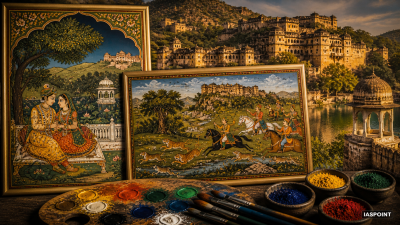
The Hadoti School, comprising the princely states of Bundi and Kota, represents a vibrant branch of Rajasthani painting. While both schools share a common origin and an obsession with lush landscapes, they diverged in their thematic focus: Bundi specialized in lyrical and romantic compositions, while Kota became the premier center for “Shikar” (hunting) art.
Bundi School: The Lyrical Masterpiece
The Bundi School is celebrated for its technical finesse and the most exquisite depiction of nature in Indian art. It emerged in the late 16th century and reached its peak between the 17th and 18th centuries.
Distinctive Stylistic Features of Bundi
- Vibrant Color Palette: Excessive use of bright colors, especially gold and silver. The school is famous for its “glowing” effect.
- Depiction of Water: Water is rendered in circular swirls with a dark blue or black base, often featuring blooming lotuses and aquatic birds.
- Physiognomy: Figures possess small round faces, sharp noses, and receding foreheads. Women are depicted with slender waists and graceful postures.
- Lush Vegetation: Dense forests with a variety of trees like plantain, mango, and pipal are a hallmark. Skies are often painted in different shades of red, blue, and gold to indicate different times of day.
Major Themes and Works
- Ragamala and Barahmasa: The Bundi Ragamala (1591) painted at Chunar is one of the earliest examples.
- Rasikapriya: Based on Keshav Das’s poetry, focusing on the divine love of Radha and Krishna.
- Chitrashala: Built by Maharao Raja Umed Singh, the walls of the Bundi Palace (Taragarh Fort) house world-renowned murals that are considered the “Versailles of India.”
Kota School: The Art of the Hunt
Kota was originally a part of Bundi and gained independence in 1631. While it inherited the Bundi style, it developed a unique identity characterized by energy, movement, and a focus on the rugged terrain of the Chambal valley.
Unique Characteristics of Kota Art
- Shikar (Hunting) Scenes: Unlike other schools where hunting was a minor theme, Kota made it a primary genre. These paintings often depict the Maharaja and his entourage hunting tigers or lions in dense jungles.
- Three-Dimensional Landscape: Kota artists excelled in creating a sense of depth through layered hills and thick foliage, a departure from the flat perspectives of earlier Rajput art.
- Patronage and Evolution: The style reached its zenith under Maharao Umed Singh I (1771–1819), who was a passionate hunter himself. During this time, the paintings became larger, sometimes resembling scrolls.
Comparative Analysis: Bundi vs. Kota
| Feature | Bundi School | Kota School |
| Primary Focus | Romanticism, Poetry, and Krishna Leela | Royal Hunts (Shikar), Power, and Nature |
| Landscape | Stylized, decorative, and ornamental | Realistic, dense, and three-dimensional |
| Human Figures | Delicate, slender, and idealized | Robust, active, and depicted in motion |
| Common Motif | Peacocks, lotuses, and monkeys | Tigers, lions, and hunting dogs |
| Technique | Finer brushwork with heavy gold leaf | Bold strokes with emphasis on action |
Notable Artists and Contributions
- Sheikh Taha and Sheikh Hussain: Early master artists associated with the Bundi tradition.
- Gumani: A prominent Kota artist known for his exceptional ability to capture the ferocity of wild animals and the topography of the Kota jungles.
- Dalchand: An artist who migrated from the Mughal court to Bundi, introducing elements of refined portraiture.
360° Fact Sheet for UPSC Prelims
- Hadoti Region: Refers to the “Land of the Hada Rajputs,” covering modern-day Bundi, Kota, Jhalawar, and Baran.
- Chunar Ragamala: This 1591 manuscript is the foundational link between the Mughal influence and the indigenous Bundi style.
- Use of Green: The Bundi school is unique for its extensive and varied use of green pigments, ranging from deep forest green to pale lime.
- Night Scenes: Bundi artists were masters at depicting night scenes, using dark blue backgrounds contrasted with white marble architecture and bright stars.
- Nathdwara Influence: Late 18th-century Kota paintings show the influence of the Vallabhacharya sect, leading to an increase in Shrinathji iconography.
- Material: Most paintings were executed on Vasli (layered handmade paper), though the region is equally famous for its grand wall frescoes (Murals).
Trivia: The “Green” Secret
The brilliant green seen in Bundi paintings was often achieved by mixing orpiment (yellow arsenic) with indigo. Over centuries, some of these greens have oxidized, giving the foliage a unique brownish-golden hue in older manuscripts.
Last Modified: May 5, 2026