
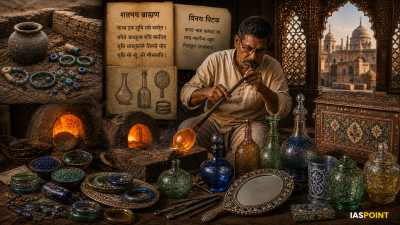
The history of glassmaking in India is an ancient science, with archaeological evidence tracing back to the painted grey ware culture (c. 1000 BCE). Mention of glass is found in the Satapatha Brahmana and the Vinaya Pitaka, where it was referred to as Kanch. Historically, the craft evolved from making simple beads and bangles to sophisticated flasks and mirrors during the Mughal era, influenced significantly by Persian techniques.
Major Centers of Glass Production
Glass handicrafts are geographically concentrated in specific clusters, each specializing in unique production styles and glass compositions.
- Firozabad (Uttar Pradesh): Known as the “Glass City of India” or “Suhag Nagari,” it is the global hub for glass bangles and glassware. Almost every household is involved in some stage of glass blowing or finishing.
- Saharanpur (Uttar Pradesh): Specializes in high-quality glass toys and decorative items, often utilizing scientific glass-blowing techniques.
- Purdilpur (Uttar Pradesh): A major center for the production of glass beads used in jewelry and exports.
- Hyderabad (Telangana): Famous for the Laad Bazaar near Charminar, which specializes in lacquer-encrusted glass bangles.
- Kapren (Rajasthan): Known for traditional glass-melting and mouth-blowing techniques.
Diverse Techniques in Glass Crafting
Indian artisans employ various manual and semi-mechanical methods to shape and decorate glass.
| Technique | Description | Applications |
| Glass Blowing | Air is blown into molten glass through a pipe to create hollow shapes. | Vases, lamps, and decorative globes. |
| Glass Engraving | Carving designs onto the surface of the glass using diamond-tipped tools. | Awards, trophies, and premium tableware. |
| Lampworking | Using a torch or lamp to melt glass rods and tubes to shape them. | Glass beads, small figurines, and toys. |
| Stained Glass | Joining colored glass pieces with lead cames to create patterns. | Church windows and decorative partitions. |
| Silvering | Applying a thin layer of silver or aluminum to the back of the glass. | Traditional mirrors and reflective mosaics. |
Specific Traditional Glass Crafts
Several unique glass crafts are distinct to Indian heritage, often integrated with other materials like metal or wood.
The Art of Bangle Making
Firozabad remains the heart of this industry. The process involves “Rezai” (cutting), “Jhalai” (joining), and “Ghardai” (polishing). Modern bangles are often embellished with “Resham” (silk thread) or gold-tinted chemicals.
Glass Inlay and Mosaic Work
- Thevara Art (Rajasthan): While primarily a gold-on-glass craft, it utilizes a base of colored glass (green, blue, or red) upon which intricate 23K gold foil is fused.
- Glass Mosaic: Commonly found in the palaces of Rajasthan (e.g., City Palace, Udaipur), where small pieces of colored glass are arranged in lime mortar to create floral and geometric patterns.
Beads and Jewelry
India is one of the world’s largest exporters of handmade glass beads. The “Moti” (bead) industry in Varanasi and Purdilpur uses furnace-winding and mandrel-winding techniques to create beads that mimic semi-precious stones.
Geographical Indications (GI) and Protection
To safeguard the authenticity of traditional glass clusters, the Government of India has granted GI tags to specific regions.
- Firozabad Glass (Uttar Pradesh): The GI status protects the entire range of glassware produced in the region, ensuring that machine-made replicas do not dilute the brand of handcrafted Firozabad products.
- Varanasi Glass Beads: Recognized for the unique manual winding technique and the use of traditional furnaces.
Technical Trivia and Prelims Facts
- Chemical Composition: Traditional Indian glass often used “Reh” (alkaline soil) and “Silica” (sand) as primary raw materials.
- Mughal Influence: The Mughals introduced the concept of “Hukkas” and “Gulabpash” (rose water sprinklers) made of glass, which were often gilded with gold.
- Scientific Glassware: Interestingly, the skills used in making glass toys have transitioned into making laboratory-grade borosilicate glassware in clusters like Saharanpur and Ambala.
- Recycling: The glass industry in India is highly sustainable, with a significant percentage of production relying on “Cullet” (recycled broken glass).
Institutional Support and Exports
The glass handicraft sector is a major foreign exchange earner, supported by several government frameworks.
- Centre for the Development of Glass Industry (CDGI): Located in Firozabad, it provides technical support, design intervention, and testing facilities to artisans.
- EPCH (Export Promotion Council for Handicrafts): Facilitates the participation of glass artisans in international fairs like IHGF Delhi Fair.
- One District One Product (ODOP): Firozabad is designated under the ODOP scheme for glass products, focusing on enhancing export infrastructure and skill development.