
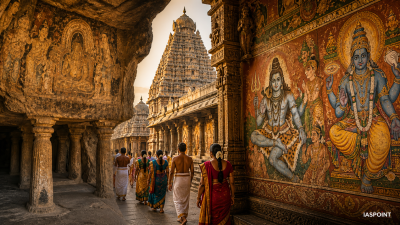
The transition of Indian mural painting from rock-cut caves to the walls of structural temples reached its aesthetic and technical zenith under the Chola and Vijayanagara Empires. While the Ajanta tradition focused on Buddhist narratives, the medieval South Indian traditions were predominantly Brahmanical, serving as visual hagiographies of Shiva and Vishnu. These murals were not mere decorations but were integrated into the “Agamic” architecture of the temples, facilitating a circumambulatory (Pradakshina) experience for the devotee.
Chola Mural Tradition (9th – 13th Century CE)
The Chola period, particularly during the reign of Rajaraja I and Rajendra I, marked the “Golden Age” of classical South Indian painting. The most significant discovery of this period occurred in the 1930s at the Brihadisvara Temple, where Chola murals were found hidden beneath 16th-century Nayaka paintings.
Technical and Stylistic Features
- Fresco Technique: Unlike the “Fresco-secco” of Ajanta, Chola artists often employed a “True Fresco” technique where pigments were applied to wet lime plaster, allowing the colors to penetrate deep into the wall surface.
- Sinuous Lines: The figures are characterized by graceful, flowing curves and the classic Tribhanga (triple-bend) posture, maintaining the elegance of the earlier Pallava and Chalukyan styles.
- Color Palette: Dominated by natural earth tones such as warm yellows, deep reds, and brownish blacks, with a notable absence of bright blues.
- Iconographic Precision: The murals strictly follow the Shilpa Shastras, ensuring the anatomical and symbolic accuracy of divine figures.
Key Masterpieces: Brihadisvara Temple, Thanjavur
- Tripurantaka Shiva: A massive mural depicting Lord Shiva as the destroyer of the three demon cities (Tripura), showcasing high dynamism and warrior-like vigor.
- Saint Sundarar’s Journey: A narrative sequence depicting the life of the Shaivite saint Sundaramurti Nayanar and his journey to Mount Kailash on a white elephant.
- Rajaraja and Karuvur Devar: A rare historical depiction showing the Emperor Rajaraja I with his spiritual guru, Karuvur Devar.
Vijayanagara Mural Tradition (14th – 16th Century CE)
With the rise of the Vijayanagara Empire, the mural tradition shifted toward a more stylized, decorative, and narrative-heavy form. This era bridged the gap between classical murals and the later “Kalamkari” and miniature traditions.
Evolution of Style and Aesthetics
- Linearity and Profile: Moving away from the rounded modeling of the Chola period, Vijayanagara figures feature sharp, angular outlines and are often shown in profile or three-quarter view.
- Decorative Elaborations: Extensive focus on detailed textile patterns, jewelry, and elaborate headgears (Kiritas).
- Architectural Integration: Murals were typically painted on the ceilings of the Mandapas (pillared halls) rather than just the inner sanctum walls.
- Narrative Panels: Stories are organized in horizontal registers, similar to a comic strip, making the complex Puranic myths accessible to the masses.
Key Sites and Iconic Murals
- Virabhadra Temple, Lepakshi: Home to the largest mural of Lord Virabhadra in India. The ceiling of the Mahamandapa features scenes from the Ramayana, Mahabharata, and the “Marriage of Parvati.”
- Virupaksha Temple, Hampi: Features a famous mural of the “Procession of Vidyaranya” (the spiritual founder of the empire) and the “Ten Incarnations of Vishnu” (Dashavatara).
- Chennakesava Temple, Somnathpur: Though primarily famous for sculpture, the remnants of paintings show a transition toward the Hoysala-influenced Vijayanagara style.
Comparative Analysis: Chola vs. Vijayanagara Murals
| Feature | Chola Murals | Vijayanagara Murals |
| Primary Era | 11th Century (Rajaraja I). | 14th – 16th Century. |
| Location | Sanctum walls (hidden layers). | Mandapa ceilings and corridors. |
| Technique | True Fresco (wet lime). | Fresco-secco (dry plaster). |
| Visual Form | Rounded, voluminous, naturalistic. | Angular, stylized, two-dimensional. |
| Eyes | Meditative and proportionate. | Large, elongated, and protruding. |
| Background | Minimal or cosmic. | Highly ornate with floral/geometric fillers. |
Successor Traditions: Nayaka and Kerala Murals
- Nayaka Continuity: The Nayakas of Madurai and Thanjavur (17th century) continued the Vijayanagara style but increased the use of vibrant colors and crowded compositions. They often painted over original Chola murals.
- Kerala Murals: Flourishing in temples like Padmanabhaswamy and Vadakkunnathan, this school evolved from the Vijayanagara style but developed a unique “volumetric” look with deep reds and greens and a distinct focus on the Panchamala (five colors).
Fact-File for UPSC Prelims
- S.K. Govindaswamy: The historian credited with the 1931 discovery of the Chola murals beneath the Nayaka layers at Thanjavur.
- The Lepakshi Saree: The intricate textile designs depicted in Vijayanagara murals at Lepakshi continue to influence modern South Indian saree patterns.
- Pigment Sources: While Cholas used pure mineral pigments, Vijayanagara and Nayaka artists began incorporating vegetable dyes, which changed the aging characteristics of the art.
- Agamic Context: These murals are considered “Chitra-Abhasa” (the semblance of a painting) in Sanskrit texts, meant to aid in the visualization of the deity during dhyana (meditation).
- UNESCO Significance: The Brihadisvara Temple (part of the Great Living Chola Temples) is a UNESCO World Heritage site, with its murals cited as a critical component of its “Outstanding Universal Value.”
Conservation and Challenges
The primary challenge for Chola murals is “De-layering”—the delicate process of removing later Nayaka paintings to reveal the Chola masterpieces without damaging either. Environmental factors such as humidity in the Kaveri delta and soot from ritualistic lamps have historically affected the vibrancy of the pigments. Current conservation efforts by the Archaeological Survey of India (ASI) use non-invasive scanning to document these layers before any physical intervention.
Last Modified: May 4, 2026