
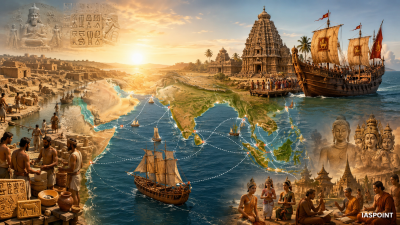
India’s geographical position at the center of the Indian Ocean made it a natural pivot for maritime trade. From the Indus Valley Civilization’s links with Mesopotamia to the Chola Dynasty’s naval expeditions, the “Indosphere” expanded not through military conquest, but through a process of “Indianization”—the peaceful diffusion of culture, language, and religion.
Principal Maritime Trade Routes
The spread of Indian culture was facilitated by two primary maritime corridors:
- The Western Route: Connecting the Malabar Coast and Gujarat to the Persian Gulf, Red Sea, and the Roman Empire. This route facilitated the exchange of ideas with the Hellenistic world.
- The Eastern Route: Connecting the Coromandel Coast and Bengal to Southeast Asia (Suvarnabhumi) and China via the Strait of Malacca.
Diffusion of Religion and Philosophy
Maritime trade acted as a vehicle for the two major missionary religions of India, transforming the socio-religious landscape of Asia.
Expansion of Buddhism
Buddhism traveled alongside merchants who sought divine protection during perilous voyages.
- Sri Lanka: Ashoka’s son Mahendra and daughter Sanghamitra carried the Bodhi tree sapling to Anuradhapura.
- Southeast Asia: The maritime Silk Road carried Mahayana Buddhism to the Srivijaya Empire (Sumatra) and the Sailendra Dynasty (Java), leading to the construction of Borobudur, the world’s largest Buddhist monument.
- East Asia: Monks like Bodhidharma traveled by sea to China, eventually influencing the development of Zen Buddhism.
Spread of Hinduism and Brahmanical Culture
Hinduism, particularly Shaivism and Vaishnavism, influenced the royalty of Southeast Asian kingdoms.
- Agastya Cult: The Vedic sage Agastya is venerated across Indonesia as a maritime deity who “drank the ocean” to assist the gods.
- Royal Titles: Rulers in Cambodia and Thailand adopted the title “Varman” (e.g., Jayavarman), following the Pallava tradition of South India.
Architectural and Iconographic Influence
Indian temple architecture served as the blueprint for monumental structures across the Indian Ocean.
| Region | Primary Indian Influence | Landmark Example |
| Cambodia | Dravidian and Gupta styles | Angkor Wat: Dedicated to Vishnu; reflects Mount Meru cosmology. |
| Indonesia | Pallava and Pala architecture | Prambanan: Massive Hindu temple complex in Central Java. |
| Vietnam | Champa architecture (Shaivite) | My Son Sanctuary: Reflects the influence of Amaravati school of art. |
| Thailand | Dvaravati and Ayutthaya styles | Wat Phra Kaew: Displays Ramayana murals (Ramakien). |
Linguistic and Literary Impact: The Sanskrit Legacy
Sanskrit became the lingua franca of the elite in Southeast Asia, providing a vocabulary for administration, law, and literature.
- Scripts: South Indian scripts like Brahmi and Pallava-Grantha evolved into modern Southeast Asian scripts, including Thai, Khmer, Javanese, and Burmese.
- The Epics: The Ramayana and Mahabharata were localized into versions like the Ramakien (Thailand), Kakawin Ramayana (Indonesia), and Reamker (Cambodia). These epics remain the foundation of traditional dance and shadow puppetry (Wayang Kulit).
Economic Commodities and Cultural Exchange
Trade items were often imbued with cultural significance, leading to a “material culture” exchange.
- Textiles: Indian cotton (Chintz and Patola) was highly prized in Indonesia and used as sacred heirlooms.
- Spices: The quest for pepper and cardamom brought Indian traders to the “Spice Islands” (Moluccas), establishing permanent Indian merchant settlements (Manigramam and Nanadesis).
- Mathematical Systems: Indian numerals and the concept of Zero reached the Arab world via maritime trade (Hindusatwa), eventually traveling to Europe.
The Role of Merchant Guilds
The expansion was organized by powerful merchant guilds that acted as autonomous cultural ambassadors.
- Anjuvannam: A guild consisting of Jewish, Christian, and Muslim traders operating from the Kerala coast.
- Nanadesi and Ayyavole 500: These guilds established “Indian Quarters” in foreign ports, building temples and hospitals, which served as the first “Diaspora” community centers.
Factful Trivia for Prelims
- Suvarnabhumi: Ancient Indian texts referred to Southeast Asia as the “Land of Gold.”
- Bali, Indonesia: The only region outside India where a form of Agamic Hinduism remains the majority religion, preserving ancient Vedic rituals lost in mainland India.
- The Chola Navy: Under Rajendra Chola I, the navy launched a successful expedition against the Srivijaya Kingdom in 1025 CE to secure trade routes to China.
- Khetri Copper: Recent archaeological evidence suggests copper from Rajasthan reached the Persian Gulf as early as the 3rd millennium BCE.
- Shipbuilding: The Yukti Kalpataru is an ancient Sanskrit text providing detailed instructions on shipbuilding, categorizing ships into Samanya (riverine) and Vishesha (ocean-going).