
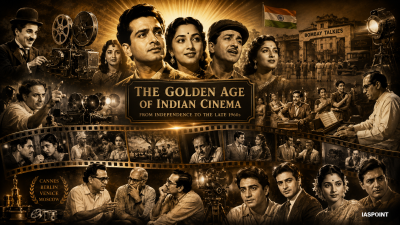
The “Golden Age” of Indian Cinema refers to the period following India’s independence until the late 1960s. This era is characterized by the confluence of technical maturity, the rise of Parallel Cinema, and the emergence of legendary actors and filmmakers who transitioned Indian films from mere entertainment to a respected art form on the global stage.
Transition to Social Realism and Intellectualism
Post-Independence cinema moved away from the mythological themes of the silent era toward “Social Realism.” Filmmakers began addressing the aspirations, struggles, and disillusionment of a newly decolonized nation.
- Social Reformist Narrative: Films focused on issues like rural poverty, urban exploitation, and the caste system.
- The Big Three Directors: This era was dominated by the distinct styles of Mehboob Khan, Raj Kapoor, and Bimal Roy.
Landmarks of the Golden Age
Several films from this period are considered milestones in world cinema for their narrative depth and technical innovation.
| Film | Year | Director | Significance |
| Neecha Nagar | 1946 | Chetan Anand | First Indian film to win the Grand Prix (Palme d’Or) at Cannes. |
| Do Bigha Zamin | 1953 | Bimal Roy | Influenced by Italian Neorealism; highlighted the plight of the peasantry. |
| Pather Panchali | 1955 | Satyajit Ray | Part of the Apu Trilogy; put Indian cinema on the global map of high art. |
| Mother India | 1957 | Mehboob Khan | India’s first nomination for the Academy Award for Best Foreign Language Film. |
| Mughal-e-Azam | 1960 | K. Asif | Defined the “Historical Epic” genre with unparalleled production scale. |
The Emergence of Parallel Cinema (The Indian New Wave)
Parallel Cinema emerged as an alternative to the mainstream song-and-dance formula. It originated in Bengal and was spearheaded by filmmakers who prioritized realism and socio-political critique over commercial viability.
- Satyajit Ray: Known for the Apu Trilogy (Pather Panchali, Aparajito, Apur Sansar). He is the only Indian to receive an Honorary Oscar for Lifetime Achievement (1992).
- Ritwik Ghatak: Focused on the trauma of the Partition of Bengal. His “Partition Trilogy” (Meghe Dhaka Tara, Komal Gandhar, Subarnarekha) is a seminal work in Indian cinema.
- Mrinal Sen: Known for his Marxist leanings and experimental narratives, such as Bhuvan Shome (1969), which officially launched the New Cinema Movement.
Technical and Artistic Advancements
The Golden Age saw significant shifts in the “grammar” of Indian filmmaking, particularly in cinematography and music.
- Cinematography: Subrata Mitra (Ray’s cinematographer) pioneered “Bounce Lighting,” creating a more naturalistic look compared to the flat lighting of the studio era.
- Music and Poetry: This period is often called the “Golden Era of Film Music.” Lyricists like Sahir Ludhianvi and Shailendra, and composers like Naushad and S.D. Burman, integrated Urdu poetry and Indian classical music into cinema.
- Aura of the “Star”: The era saw the rise of the “Triumvirate” of Hindi Cinema—Dilip Kumar (The Tragedy King), Raj Kapoor (The Chaplin of India), and Dev Anand (The Evergreen Star).
Regional Cinema Milestones
While Bombay (Hindi) and Calcutta (Bengali) were the primary hubs, other regions made significant cultural contributions.
- South Indian Cinema: The 1950s saw the rise of iconic figures like Sivaji Ganesan and M.G. Ramachandran in Tamil cinema, and N.T. Rama Rao in Telugu cinema. Mayabazar (1957) remains a landmark for its visual effects in Telugu/Tamil cinema.
- Marathi Cinema: Continued the legacy of the Prabhat Studio with films like Shyamchi Aai (1953), which won the first National Film Award for Best Feature Film.
Facts and Trivia for UPSC Prelims
- First National Film Awards: Instituted in 1954 (for films released in 1953). Shyamchi Aai (Marathi) was the first recipient of the President’s Gold Medal.
- Academy Award Nomination: Mother India (1957) lost the Oscar by a single vote to the Italian film Nights of Cabiria.
- Guru Dutt: A visionary of this era whose films Pyaasa (1957) and Kaagaz Ke Phool (1959) are frequently included in “All-Time Best” lists by Time Magazine and Sight & Sound.
- Bhanu Athaiya: Although she won the Oscar later (1983) for Gandhi, her career began during this era, defining the aesthetic of the 1950s and 60s.
- The “Cinema Girl” Image: Figures like Nargis, Madhubala, and Meena Kumari (The Tragedy Queen) broke stereotypes and became central to the narrative, rather than just supporting characters.