
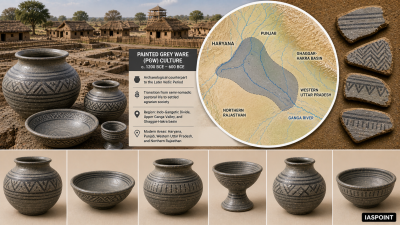
The Painted Grey Ware (PGW) culture marks a significant epoch in the proto-history of Northern India, flourishing approximately between 1200 BCE and 600 BCE. It is widely regarded as the archaeological counterpart to the Later Vedic Period, representing the transition from a semi-nomadic pastoral life to a settled agrarian society. This culture is primarily concentrated in the Indo-Gangetic Divide, the Upper Ganga Valley, and the Ghaggar-Hakra basin, covering modern-day Haryana, Punjab, Western Uttar Pradesh, and Northern Rajasthan.
Ceramic Technology and Characteristics
The PGW ceramic is distinguished by its superior quality and technical precision, reflecting an advanced understanding of kiln control and clay processing.
- Fabric and Texture: PGW is a very fine, thin-walled pottery made from high-quality alluvial silt. The core is typically grey, and the texture is smooth and well-levigated.
- Firing Process: The characteristic grey color was achieved by firing the vessels in a reducing atmosphere (limited oxygen) within a closed kiln at consistently high temperatures.
- Aesthetics and Painting: The surface is decorated with geometric patterns—such as linear strokes, dots, dashes, concentric circles, and swastikas—painted in black or deep chocolate brown before firing.
- Deluxe Ware Status: Due to its fine finish and relative scarcity compared to contemporary “Red Ware,” archaeologists believe PGW served as a “luxury” or “elite” tableware for special occasions or upper-class households.
Geographic Distribution and Significant Sites
The PGW culture spans a vast area, often referred to as the “Madhyadesha” in ancient texts.
| State | Key Archaeological Sites |
| Haryana | Bhagwanpura, Pehowa, Raja-Karna-ka-Qila, Kurukshetra |
| Uttar Pradesh | Hastinapur, Ahichchhatra, Atranjikhera, Mathura, Kampil |
| Punjab | Ropar (Rupnagar), Dadheri, Sanghol |
| Rajasthan | Noh, Jodhpura, Bairat |
The Iron Age Revolution and Economy
The PGW phase is synonymous with the widespread introduction of Iron technology in the Indian subcontinent, which catalyzed socio-economic shifts.
- Metallurgy: While copper continued to be used for ornaments and small tools, iron was utilized for weaponry (arrowheads, spearheads) and, crucially, for agricultural implements like hoes and sickles.
- Agriculture: The use of iron allowed for the clearing of the dense forests of the Ganga Valley. Crops cultivated included rice (vrihi), wheat (godhuma), and barley (yava).
- Animal Husbandry: Cattle remained a primary source of wealth and labor. Excavations have yielded bones of cows, buffaloes, sheep, and horses.
- Settlement Pattern: This period saw the rise of large, fortified settlements and the earliest traces of town planning, which would eventually culminate in the second urbanization.
Comparison: PGW vs. Contemporary Traditions
The PGW culture did not exist in isolation; it frequently overlapped or co-existed with other regional traditions.
| Feature | Painted Grey Ware (PGW) | Black and Red Ware (BRW) |
| Primary Color | Uniform Grey | Bi-color (Black inside, Red outside) |
| Technique | Reducing atmosphere (Closed kiln) | Inverted firing |
| Status | Elite/Deluxe tableware | Common/Utilitarian household ware |
| Regional Core | Upper Ganga Valley / Haryana | Middle Ganga Valley / Central India |
| Period | Early Iron Age (Later Vedic) | Chalcolithic to Early Iron Age |
Linkage with Vedic Literature
One of the most compelling aspects of PGW is its strong correlation with the geography and material culture described in the Later Vedic texts (Sama, Yajur, and Atharva Vedas, and the Brahmanas).
- The Kuru-Panchala Connection: Many PGW sites, such as Hastinapur and Ahichchhatra, are the legendary capitals of the Kuru and Panchala kingdoms mentioned in the Mahabharata.
- Material Parallels: The emphasis on glass beads, iron weapons, and the prominence of the horse in PGW strata mirrors the descriptions of the heroic society in the Later Vedic corpus.
- The Bhagwanpura Evidence: At Bhagwanpura (Haryana), archaeologists found evidence of a “Late Harappan” culture overlapping with PGW, suggesting a rare instance of cultural continuity rather than a sudden break between the Indus and Vedic civilizations.
Key Facts for UPSC Prelims
- First Identification: PGW was first identified at the site of Ahichchhatra (UP) in 1946, but its stratigraphic importance was established by B.B. Lal at Hastinapur in 1950-52.
- The “Grey” Marker: The presence of PGW is considered the definitive marker for the Early Iron Age in Northern India.
- Glass Technology: The PGW culture provides some of the earliest evidence of glass manufacturing in India, primarily in the form of bangles and beads.
- Rice Culture: Unlike the early Harappans who were primarily wheat-based, the PGW people in the Doab showed a distinct preference for rice cultivation.
- Successor Culture: PGW was succeeded by the Northern Black Polished Ware (NBPW), which is associated with the rise of the Mauryan Empire and the peak of the second urbanization.