
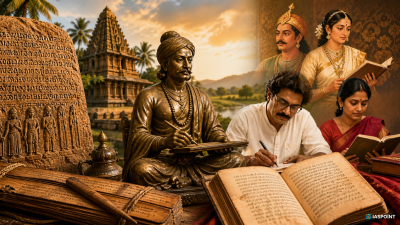
Telugu literature, often referred to as “The Italian of the East” due to its vowel-ending words (Ajanta Bhasha), has a rich history spanning over a millennium. It is a member of the Dravidian language family but has been profoundly influenced by Sanskrit and Prakrit. The literary journey of Telugu is traditionally divided into several epochs, moving from early inscriptions to the “Prabandha” style of the medieval era and eventually to modern social realism.
Early Beginnings and the Pre-Nannaya Period
Before formal literary works emerged, Telugu existed in inscriptions and folk traditions.
- Earliest Evidence: The Erragudipadu inscription (575 AD) of the Renati Cholas is considered the earliest Telugu inscription.
- Gatha Saptashati: Composed in Maharashtri Prakrit by the Satavahana King Hala (1st Century AD), it contains several Telugu words, indicating the language’s antiquity.
- Desi Kavita: The early period was dominated by indigenous folk forms like Padams and Yatshaganas before the dominance of the Marga (Sanskritized) style.
The Era of the Kavitrayam (The Trinity of Poets)
The formalization of Telugu literature began with the translation of the Mahabharata. The three poets who completed this monumental task are known as the Kavitrayam.
| Poet | Period | Contribution | Special Title |
| Nannaya Bhattaraka | 11th Century | Wrote the first 2.5 Parvas (chapters) of the Andhra Mahabharatam. | Adi Kavi (The First Poet) |
| Tikkana Somayaji | 13th Century | Translated 15 Parvas (from Virata Parva onwards). | Kavi Brahma |
| Errana (Erraga) | 14th Century | Completed the remaining half of the Aranya Parva. | Prabandha Parameshwara |
- Andhra Sabda Chintamani: Nannaya is also credited with the first Telugu grammar book written in Sanskrit.
The Golden Age: Vijayanagara Empire and Prabandha Literature
The reign of Sri Krishnadevaraya (1509–1529) is considered the “Golden Age of Telugu Literature.” The King himself was a scholar of high repute and a great patron of arts.
The Ashtadiggajas
The court of Krishnadevaraya, known as the Bhuvana Vijayam, was adorned by eight great poets called the Ashtadiggajas.
- Allasani Peddana: Known as the Andhra Kavita Pitamaha. His work Manucharitra established the Prabandha genre (a story with a mix of various rasas and descriptive elements).
- Nandi Thimmana: Authored Parijatapaharanam.
- Tenali Ramakrishna: Famous for his wit and the work Panduranga Mahatmyam, which is considered one of the five great Telugu Kavyas.
- Dhurjati: A staunch Shaivite who wrote Sri Kalahasteeshwara Shatakam.
- Pingali Surana: Authored Kalapurnodayam, often cited as the first original Telugu novel in poetic form.
- Sri Krishnadevaraya’s Amuktamalyada: Written by the Emperor himself, this epic describes the life of the Alvar saint Andal. It is a masterpiece of the Prabandha style.
The Five Great Epics (Pancha Kavyas) of Telugu
Just as Tamil has its five epics, Telugu tradition recognizes five works of unparalleled literary merit:
- Amuktamalyada by Sri Krishnadevaraya.
- Manucharitra by Allasani Peddana.
- Panduranga Mahatmyam by Tenali Ramakrishna.
- Vasucharitra by Ramarajabhushana.
- Vijayavilasam by Chemakura Venkata Kavi.
Significant Literary Genres and Forms
- Shatakam (The Century of Verses): A unique genre where 100 or 108 verses end with a common “Makutam” (refrain/crown).
- Vemana Shatakam: Composed by Yogi Vemana, these verses focus on social reform and moral values in simple language.
- Sumati Shatakam: Attributed to Baddena, it is a staple for moral education in Telugu households.
- Dvivada: A couplet form of poetry that made literature accessible to commoners. Palkuriki Somanatha, a 13th-century Virashaiva poet, pioneered this with his Basava Puranam.
- Yatshagana: A traditional folk theater form combining music, dance, and dialogue, which flourished during the Nayaka period in Tanjore and Madurai.
Southern School of Telugu Literature (Dakshina Andhra Era)
After the fall of the Vijayanagara Empire, the center of Telugu literature shifted to the Nayaka kingdoms of Tanjore and Madurai.
- Raghunatha Nayaka and Vijayapaghava Nayaka were notable patrons and authors.
- This era saw the rise of female poets like Rangajamma (author of Mannarudasa Vilasam) and Muddupalani (author of the erotic-spiritual poem Radhika Santwanam).
Modern Telugu Literature and Social Reform
The 19th and 20th centuries marked a shift from courtly poetry to social themes, influenced by the British Raj and the Indian National Movement.
- Kandukuri Veeresalingam: Known as the “Father of Modern Telugu Renaissance.” He wrote the first Telugu novel, Rajasekhara Charitra, and used literature as a tool for widow remarriage and women’s education.
- Gurazada Apparao: His play Kanyasulkam (1892) attacked the practice of bride-price and was the first play written in the spoken dialect (Vyavaharika Bhasha).
- Gidugu Ramamurthy: Led the Vyavaharika Bhasha movement to bridge the gap between written and spoken Telugu.
- Sri Sri (Srirangam Srinivasa Rao): The pioneer of the Abhyudaya (Progressive) movement. His work Mahaprasthanam changed the face of Telugu poetry with its focus on the marginalized and the working class.
Key Facts and Trivia for UPSC Prelims
- Classical Status: Telugu was the second language (after Tamil) to be designated as a Classical Language by the Government of India in 2008.
- The Bammera Potana Factor: Unlike other court poets, Potana was a “Sahaja Kavi” (natural poet) who refused royal patronage. His Andhra Maha Bhagavatam is celebrated for its rhythmic beauty and devotion.
- Linguistic Identity: The word “Telugu” is believed to have derived from “Trilinga,” referring to the three Shiva temples at Srisailam, Kaleshwaram, and Draksharamam.
- C.P. Brown: A British administrator who played a monumental role in reviving Telugu literature in the 19th century by collecting, editing, and printing ancient manuscripts.
- National Identity: The Telugu song “Maa Telugu Talliki” (To Our Telugu Mother) serves as the state anthem of Andhra Pradesh, symbolizing the cultural unity of the Telugu-speaking people.