
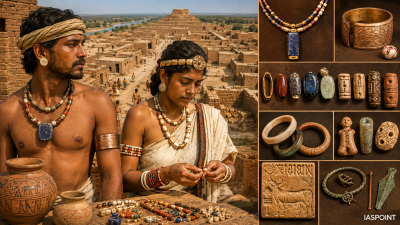
The Indus Valley Civilization (IVC), spanning approximately 3300 BCE to 1300 BCE, represents the bedrock of Indian lapidary arts. Harappan jewellery was characterized by a sophisticated understanding of metallurgy, semi-precious stones, and aesthetics. Both men and women across all social strata wore ornaments, though the materials used served as indicators of socio-economic status. While the elite wore gold, silver, and semi-precious stones like lapis lazuli, the commoners utilized shell, bone, terra cotta, and copper.
Categorization of Harappan Ornaments
The jewellery of the IVC can be classified based on the anatomy of wear and the gender of the wearer. Excavations at sites like Mohenjo-daro and Harappa reveal a high degree of standardization in design.
Common Ornaments for Both Genders
- Necklaces: Multi-stranded beads made of gold, steatite, and carnelian were ubiquitous.
- Fillets and Headbands: Thin ribbons of gold or silver used to keep hair in place.
- Armlets and Bangles: Found in abundance, these were crafted from shell, terra cotta, and metals.
- Finger Rings: Simple bands and rings with bezel settings for stones were common.
Gender-Specific Ornaments
- Girdles: Primarily worn by women to cinch the waist; these were often elaborate with multiple rows of beads.
- Earrings and Ear-studs: Predominantly found in female burials and depicted on female figurines.
- Anklets: Heavy copper or bronze rings worn around the ankles, specifically by women.
Lapidary Techniques and Bead Manufacturing
The Harappans were master bead-makers, a fact evidenced by the discovery of specialized workshops. The bead-making industry was centered at sites like Chanhudaro and Lothal.
Materials Used in Bead Making
- Semi-Precious Stones: Carnelian (red), Lapis Lazuli (blue), Jasper, Crystal, Quartz, and Turquoise.
- Metals: Gold, Silver, Copper, and Bronze.
- Organic/Synthetics: Steatite (soapstone), Faience (a glazed vitreous material), Shell, Bone, and Terra cotta.
Technical Innovations
- Long-Barrel Cylinder Beads: Harappans were famous for creating exceptionally long carnelian beads, some exceeding 10 cm, which required advanced drilling technology.
- Etched Carnelian: A unique process where white patterns were etched onto red carnelian using an alkaline solution (usually juice from the Capparis aphylla plant) and then firing it.
- Micro-Beads: The production of minute steatite beads, some less than 1 mm in diameter, showcases the precision of Harappan craftsmanship.
Major Archaeological Sites and Findings
Specific IVC sites have provided landmark evidence of the civilization’s ornamental prowess.
| Site | Significant Jewellery Findings |
| Mohenjo-daro | The “Dancing Girl” statue wearing a series of bangles; gold necklaces and carnelian beads. |
| Chanhudaro | A dedicated bead-making factory with finished and unfinished beads, drills, and smelting tools. |
| Lothal | A major port city and bead-making center; findings of gold pendants and carnelian ornaments. |
| Farmana (Haryana) | A cemetery site that revealed bangles and beads placed as funerary offerings. |
| Allahdino | A massive hoard of gold, silver, and carnelian jewellery, including a multi-strand gold necklace. |
| Kunal (Haryana) | Known for the discovery of two silver crowns, suggesting early social stratification. |
Socio-Cultural Significance of Jewellery
In Harappan society, jewellery was not merely decorative but also carried symbolic and functional value.
Rituals and Burials
Unlike the Egyptians, Harappans did not bury their dead with immense wealth. However, modest amounts of jewellery—usually shell bangles, steatite beads, and copper rings—were placed in graves, indicating a belief in the afterlife or the preservation of personal identity.
Social Stratification
The distribution of materials indicates a clear hierarchy. Gold and Lapis Lazuli (imported from the Badakhshan region of Afghanistan) were reserved for the urban elite. The widespread use of Faience—a “synthetic” gemstone—suggests an attempt to provide affordable luxury to the middle classes.
Trade and Economy
The jewellery industry was a significant driver of Harappan trade. Finished beads were exported to Mesopotamia (Sumer), where they have been found in the Royal Cemetery at Ur. This establishes the IVC as a global hub for luxury goods in antiquity.
Key Facts for UPSC Prelims
- The Dancing Girl: She wears 24 to 25 bangles on her left arm and 4 on her right arm, highlighting the asymmetry in fashion.
- Soldering: Harappans were proficient in soldering gold and silver, using it to join delicate pieces of jewellery.
- Steatite: This was the most common material for beads because it was soft enough to carve and hardened significantly after firing.
- Standardization: Even without a central mint, Harappan beads followed specific weight and size standards, reflecting a highly organized guild system.
- The “Priest King”: The sculpture from Mohenjo-daro depicts an ornament worn on the forehead (fillet) and a decorative armband, indicating male use of jewellery.