
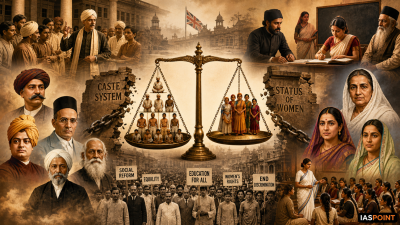
The 19th and early 20th centuries witnessed a series of social reform movements aimed at restructuring the Indian social fabric. These movements were a response to the challenges posed by colonial rule, Western education, and the perceived internal decay of traditional customs. These reforms targeted the twin pillars of social hierarchy: the Caste System and the Status of Women.
Classification of Reform Movements
Historians generally categorize these movements into two distinct types based on their ideological approach toward tradition and modernity:
- Reformist Movements: Aimed at responding to the challenges of the time by introducing changes within the existing social and religious framework. Examples include the Brahmo Samaj, Prarthana Samaj, and the Aligarh Movement.
- Revivalist Movements: Sought to “revive” a pristine past or golden age of the religion, often arguing that contemporary social evils were later accretions. Examples include the Arya Samaj, Theosophical Society, and the Deoband Movement.
Major Reform Organizations and Their Contributions
The following table summarizes the key organizations that shaped India’s social and cultural heritage:
| Organization | Founder | Year | Core Social Agenda |
| Brahmo Samaj | Raja Ram Mohan Roy | 1828 | Abolition of Sati, monotheism, opposition to idol worship and polygamy. |
| Arya Samaj | Dayanand Saraswati | 1875 | “Back to Vedas,” abolition of untouchability, Shuddhi movement, education. |
| Prarthana Samaj | Atmaram Pandurang | 1867 | Inter-caste dining, inter-caste marriage, widow remarriage, upliftment of women. |
| Satyashodhak Samaj | Jyotiba Phule | 1873 | Anti-caste struggle, education for Shudras and Ati-shudras, human rights. |
| Ramakrishna Mission | Swami Vivekananda | 1897 | Social service, humanitarian relief, spiritual egalitarianism. |
| Theosophical Society | HP Blavatsky & HS Olcott | 1875 | Universal brotherhood, revival of Hindu philosophy (led by Annie Besant in India). |
| Self-Respect Movement | E.V. Ramasamy (Periyar) | 1925 | Anti-Brahminism, radical social equality, self-respect marriages without priests. |
Specific Social Reforms and Legal Milestones
The reform movements exerted pressure on the British administration to enact laws that fundamentally altered traditional customs.
Reforms Concerning the Status of Women
- Abolition of Sati (1829): Championed by Raja Ram Mohan Roy; the Bengal Sati Regulation was passed by Lord William Bentinck.
- Widow Remarriage Act (1856): Ishwar Chandra Vidyasagar presented a petition with 925 signatures, leading Lord Dalhousie to draft the act (passed by Lord Canning).
- Age of Consent Act (1891): Raised the age of consent for sexual intercourse for all girls, married or unmarried, from ten to twelve years; strongly supported by B.M. Malabari.
- Sarda Act / Child Marriage Restraint Act (1929): Named after Harbilas Sarda, it fixed the marriageable age for girls at 14 and boys at 18.
Reforms Concerning the Caste System
- Vaikom Satyagraha (1924–25): Led by K.P. Kesava Menon in Kerala to secure temple entry for “untouchables” and the use of roads near the Vaikom Temple.
- Harijan Sevak Sangh (1932): Founded by Mahatma Gandhi following the Poona Pact to work for the removal of untouchability and the upliftment of the Depressed Classes.
- Temple Entry Proclamation (1936): Issued by the Maharaja of Travancore, allowing all Hindus regardless of caste to enter temples.
Key Ideologies and Philosophies
These movements were underpinned by distinct intellectual frameworks that sought to reconcile Indian tradition with modern ethics.
- Humanism: The belief that service to humanity is the highest form of worship, most prominently advocated by the Ramakrishna Mission.
- Rationalism: Utilizing reason to challenge superstitious practices; Raja Ram Mohan Roy is often called the “First Modern Man of India” for this approach.
- Sanskritization vs. Westernization: While some groups adopted high-caste rituals to rise in the hierarchy (Sanskritization), others adopted Western scientific outlooks to challenge the hierarchy itself.
- Bahujan Critique: Leaders like Jyotiba Phule and Dr. B.R. Ambedkar shifted the focus from “reforming” the caste system to its total “annihilation,” emphasizing the rights of the majority (Bahujans).
Significant Figures and Their Literary Contributions
The dissemination of reformist ideas was heavily dependent on the press and vernacular literature.
- Raja Ram Mohan Roy: Published Sambad Kaumudi (Bengali) and Mirat-ul-Akbar (Persian).
- Dayanand Saraswati: Authored Satyarth Prakash (The Light of Truth), interpreting the Vedas as the source of all science and morality.
- Jyotiba Phule: Wrote Gulamgiri (Slavery), dedicated to the American movement to abolish slavery, drawing parallels with the caste system in India.
- B.R. Ambedkar: Started Mooknayak and Bahishkrit Bharat to voice the grievances of the Dalits.
- Kandukuri Veeresalingam: Known as the “Father of the Renaissance in Andhra,” he focused on widow remarriage and girls’ education.
Facts and Trivia for UPSC Prelims
- Young Bengal Movement: Led by Henry Vivian Derozio, an Anglo-Indian teacher at Hindu College, who inspired students to think freely and question all authority.
- Deva Samaj: Founded by Shiv Narain Agnihotri, it shifted from Brahmo ideology to an atheistic philosophy emphasizing the “eternity of the soul.”
- Rahnumai Mazdayasnan Sabha: The Parsi Reform Society founded by Naoroji Furdonji and Dadabhai Naoroji to restore the Zoroastrian religion to its purity.
- Tattvabodhini Sabha: Established by Debendranath Tagore in 1839 to propagate the ideas of Ram Mohan Roy and systemic study of India’s past.
- The Widow Remarriage Association (1850): Founded by Vishnu Shastri Pandit in Maharashtra.
- First Widow Remarriage in North India: Conducted in Calcutta in 1856 under the supervision of Ishwar Chandra Vidyasagar.
- Dharma Sabha: Founded by Radhakant Deb as an orthodox reaction to the Brahmo Samaj; surprisingly, while it defended Sati, it promoted Western education for women.