
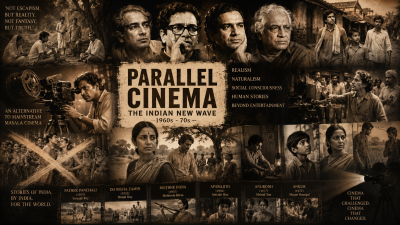
Parallel Cinema, also known as the Indian New Wave or Art Cinema, emerged as a distinct movement in the late 1940s and peaked during the 1960s and 70s. It originated as an alternative to the mainstream “Masala” films of Mumbai, rejecting the escapist song-and-dance formula in favor of social realism, naturalism, and serious socio-political commentary.
Origins and Influences
The movement was heavily influenced by Italian Neorealism and the French New Wave. It sought to portray the “authentic India”—the rural struggles, urban decay, and the psychological complexity of the middle class—using non-professional actors, location shooting, and subtle narratives.
- Pioneering Film: Neecha Nagar (1946), directed by Chetan Anand, is considered the precursor to this movement, winning the Grand Prix at the first Cannes Film Festival.
- The Neorealist Catalyst: Bimal Roy’s Do Bigha Zamin (1953) proved that realistic cinema could be commercially viable and critically acclaimed.
The Bengali Trio: The Architects of High Art
Bengal became the cradle of Parallel Cinema, led by three visionary directors whose work remains the benchmark for Indian cinematic excellence.
- Satyajit Ray: His debut Pather Panchali (1955) revolutionized Indian storytelling. His style focused on humanism and technical precision.
- Ritwik Ghatak: Unlike Ray’s subtle humanism, Ghatak’s work was visceral and obsessed with the trauma of the Partition of Bengal. His “Partition Trilogy” (Meghe Dhaka Tara, Komal Gandhar, Subarnarekha) is a cornerstone of this movement.
- Mrinal Sen: Represented the most overtly political voice. His film Bhuvan Shome (1969) is often cited as the official start of the “New Cinema” movement in India due to its experimental narrative and state funding.
Role of State Institutions
The growth of Parallel Cinema was significantly bolstered by government intervention aimed at promoting cinema as an art form rather than just a commercial industry.
- Film Finance Corporation (FFC): Established in 1960 (later becoming the NFDC or National Film Development Corporation), it provided low-interest loans to offbeat filmmakers.
- Film and Television Institute of India (FTII): Founded in 1960 in Pune, it produced a generation of trained actors and technicians like Naseeruddin Shah, Om Puri, Shabana Azmi, and Resul Pookutty.
- Directorate of Film Festivals: Created in 1973 to organize the National Film Awards and International Film Festival of India (IFFI), providing a platform for non-commercial cinema.
Regional Diversification of the New Wave
While it began in Bengal, the movement spread to other linguistic regions, each bringing unique cultural nuances to the realistic genre.
| Region | Key Filmmakers | Landmark Films |
| Kannada | Girish Karnad, B.V. Karanth, G.V. Iyer | Samskara (1970), Chomana Dudi (1975) |
| Malayalam | Adoor Gopalakrishnan, G. Aravindan | Swayamvaram (1972), Elippathayam (1981) |
| Hindi | Shyam Benegal, Mani Kaul, Kumar Shahani | Ankur (1974), Uski Roti (1969) |
| Marathi | Jabbar Patel, Amol Palekar | Ghashiram Kotwal (1976), Akriet (1981) |
Themes and Stylistic Features
Parallel Cinema broke the conventions of the “Studio System” and “Star System” through specific artistic choices:
- Social Realism: Addressing taboo subjects such as the feudal system (Ankur), Dalit oppression (Damul), and industrial exploitation.
- Minimalist Music: Eschewing the traditional “playback song” in favor of ambient sounds or classical background scores.
- Location Shooting: Moving out of artificial sets to real streets and villages to enhance the documentary-like feel.
- Anti-Hero Protagonists: Characters were often flawed, defeated, or middle-class individuals grappling with mundane survival.
Key Figures and Their Contributions
- Shyam Benegal: Introduced “Middle Cinema,” which balanced the realism of art films with a narrative structure accessible to larger audiences. His “Rural Trilogy” (Ankur, Nishant, Manthan) defined the 1970s.
- Adoor Gopalakrishnan: The face of the Kerala New Wave, known for his austere style and exploration of the Malayali psyche.
- Mani Kaul & Kumar Shahani: Represented the avant-garde wing, focusing on “Cinematic Form” rather than just the story, influenced by the teachings of Robert Bresson.
Fact Sheet for UPSC Prelims
- First National Award for Best Feature Film: Shyamchi Aai (1953) – Marathi.
- The Apu Trilogy: Consists of Pather Panchali (1955), Aparajito (1956), and Apur Sansar (1959).
- Manthan (1976): Directed by Shyam Benegal; it was the first film in the world to be entirely crowdfunded by 500,000 farmers of the Gujarat Co-operative Milk Marketing Federation (Amul).
- Bhuvan Shome (1969): Noted for being the first film to receive a loan from the FFC, sparking the 70s New Wave.
- Satyajit Ray’s Oscar: He received an Honorary Academy Award for Lifetime Achievement in 1992, shortly before his death.
- International Recognition: Elippathayam (The Rat Trap) by Adoor Gopalakrishnan won the Sutherland Trophy at the British Film Institute Awards.