
Mohiniyattam, literally translated as the “Dance of the Enchantress,” is a classical dance form from Kerala. It derives its name from ‘Mohini,’ the female avatar of Lord Vishnu, who took this form to lure the Asuras away from the Amrita (nectar of immortality) and to destroy Bhasmasura.
Archaeological and Literary Foundations
- Early References: The earliest mention of the term ‘Mohiniyattam’ is found in the 16th-century text Vyavaharamala written by Mazhamangalam Narayanan Namboodiri.
- Evolutionary Roots: While it shares roots with the Dasiyattam (temple dance) tradition, it evolved into its distinct identity by absorbing elements from two other Kerala traditions: Kathakali (for its dramatic vigor) and Koothu (for its narrative structure).
- The Royal Patronage: The dance reached its zenith in the 19th century under the patronage of Swathi Thirunal Rama Varma, the Maharaja of Travancore, who composed several Padams and Varnams specifically for this form.
Technical Characteristics and Stylistic Features
Mohiniyattam is characterized by its Lasya aspect—the graceful, feminine, and erotic sentiment—rather than the vigorous Tandava.
Posture and Body Movement
- Atibhanga: Unlike the sharp deflections of Odissi, Mohiniyattam employs soft, swaying movements of the torso and a circular movement of the body.
- Andolika: The core of the dance is the Andolika, a gentle swaying of the body from side to side, reminiscent of the swaying of coconut palms or the waves of the Kerala backwaters.
- Footwork: The footwork is subtle and does not involve the heavy, rhythmic thumping seen in Kathak or Bharatanatyam.
Abhinaya and Hand Gestures
- Hastha Lakshana Deepika: Unlike most classical dances that follow the Abhinaya Darpana, Mohiniyattam primarily follows the Hastha Lakshana Deepika for its 24 basic hand gestures (mudras).
- Mukhabhinaya: Facial expressions are restrained and subtle, focusing on the eyes and eyebrows to convey deep emotional states.
Costume, Jewelry, and Aesthetics
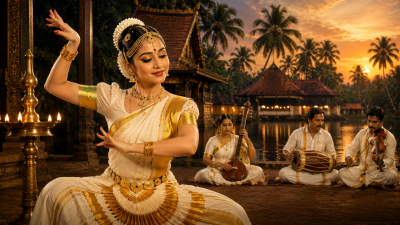
The aesthetic of Mohiniyattam is strictly defined by simplicity and elegance, mirroring the “white and gold” palette of Kerala’s traditional attire.
Attire and Hair
- Kasavu Saree: The dancer wears a pristine white or off-white silk saree with a prominent gold-laced (Kasavu) border.
- Kondakettu: The hair is tied in a distinctive side bun (Konda) on the left side, adorned with white jasmine flowers (Mulla).
Jewelry and Makeup
- Traditional Ornaments: Dancers wear authentic Kerala jewelry including the Nagaphanam (cobra-hood shaped necklace), Valayam (bangles), and the Jimikki (bell-shaped earrings).
- Netrachurna: The eyes are heavily lined with black antimony to accentuate the eye movements, while the rest of the makeup remains natural and bright.
Performance Structure and Repertoire
A typical Mohiniyattam recital follows the Sopana Sangeetham tradition and follows a specific sequence of items.
| Sequence | Description |
| Chollukettu | The inaugural piece that combines rhythmic syllables with a prayer to a deity. |
| Jatiswaram | A pure dance (Nritta) item focusing on technical brilliance and rhythmic patterns. |
| Varnam | The centerpiece of the performance, alternating between pure dance and expressive storytelling (Nritya). |
| Padam | Lyrical pieces focused on the Sringara (romantic) or Bhakti (devotional) aspects of a deity. |
| Thillana | A fast-paced concluding piece featuring complex footwork and sculptural poses. |
| Saptham | A technical piece involving seven rhythmic cycles. |
Musical Accompaniment
The musical style used in Mohiniyattam is Sopana Sangeetham, a slow, rhythmic style of singing peculiar to the temples of Kerala.
- Vocal Lyrics: Usually written in Manipravalam, a literary blend of Sanskrit and Malayalam.
- Edakka: A pressure-sensitive hourglass drum used to provide subtle rhythmic variations.
- Mridangam and Madhalam: Provide the primary rhythmic base.
- Veena and Flute: Used for melodic support.
- Kuzhitalam: Small cymbals used by the singer or Nattuvanar to maintain the beat.
Revival and Modern Exponents
Like many Indian classical forms, Mohiniyattam faced a period of decline under British rule but was revived in the early 20th century.
Key Figures in Revival
- Vallathol Narayana Menon: The nationalist poet who founded the Kerala Kalamandalam in 1930, which institutionalized the teaching of Mohiniyattam.
- Kalyanikutty Amma: Known as the “Mother of Mohiniyattam,” she is credited with reclaiming the dance from its social stigma and refining its technical structure.
Notable Contemporary Exponents
- Kanak Rele: Instrumental in the academic research of the dance and the development of the “Body Kinetic” system.
- Sunanda Nair: A leading disciple of Kanak Rele.
- Jayaprabha Menon and Pallavi Krishnan: Known for their contributions to the global propagation of the form.
Facts for UPSC Prelims
- Distinctive Mudras: Mohiniyattam is the only dance form that strictly adheres to the Hastha Lakshana Deepika for its mudra vocabulary.
- Regional Connect: It is one of the two classical dances from Kerala, the other being the male-dominated Kathakali.
- Sringara Rasa: The dance is dominated by the Vipralambha Sringara (sentiment of longing and separation).
- UNESCO Context: While Mohiniyattam itself is a classical dance, it shares its musical roots with Koodiyattam, which is a UNESCO-recognized Masterpiece of the Oral and Intangible Heritage of Humanity.
- White Color Symbolism: The white color of the costume symbolizes purity and the spiritual nature of the “Enchantress.”