
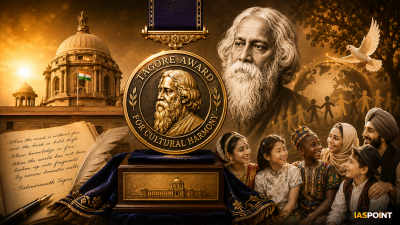
The Tagore Award for Cultural Harmony is a premium international honor instituted by the Government of India in 2012. It was established to commemorate the 150th Birth Anniversary of Gurudev Rabindranath Tagore. The award recognizes outstanding contributions toward promoting values of cultural harmony, universalism, and social cohesion, reflecting the humanist philosophy espoused by Tagore throughout his life.
Objectives and Philosophy
The award is rooted in the “Tagorean” idea of “Vishva Bharati” (Global University), which envisions a world where humanity is not divided by narrow domestic walls. It seeks to honor individuals, associations, institutions, or organizations that have worked tirelessly to bridge cultural divides and foster a spirit of brotherhood among diverse communities.
Institutional Framework and Selection Process
The award is administered by the Ministry of Culture, Government of India. The selection process is rigorous and follows a non-partisan approach to maintain the award’s international prestige.
- Jury Composition: The awardees are selected by a high-level Jury headed by the Prime Minister of India. The Jury also includes the Chief Justice of India, the Speaker of the Lok Sabha, and two other eminent persons.
- Eligibility: The award is open to all persons regardless of nationality, race, language, caste, creed, or sex. It can be awarded to an individual, a group, an organization, or an institution.
- Frequency: It is generally an annual award, though it may be conferred for multiple years simultaneously if the selection process spans several cycles.
Award Components and Privileges
The Tagore Award is one of the most financially significant cultural honors in India. It carries a substantial endowment and symbolic recognitions.
- Cash Prize: A monetary grant of 1 Crore INR (approximately 10 million rupees).
- Citation: A scroll of honor detailing the recipient’s contributions.
- Plaque: An artistically designed commemorative plaque.
- Handicraft/Handloom Item: An exquisite item of traditional Indian heritage is often presented as part of the ceremony.
List of Distinguished Recipients
Since its inception, the award has been conferred upon legendary figures from various fields including music, social activism, and traditional arts.
| Year | Recipient | Field / Contribution |
| 2012 | Pandit Ravi Shankar | Sitar maestro and global cultural ambassador who popularized Indian classical music in the West. |
| 2013 | Zubin Mehta | Renolated Western classical music conductor known for using music to foster world peace. |
| 2014 | Rajkumar Singhajit Singh | Doyen of Manipuri Dance; recognized for his contribution to the propagation of Indian classical dance. |
| 2015 | Chhayanaut | A cultural organization from Bangladesh established to promote Tagore’s works and Bengali culture. |
| 2016 | Ram Vanji Sutar | Renowned sculptor (creator of the Statue of Unity) known for his monumental works reflecting Indian heritage. |
Significant Facts for UPSC Prelims
- Nomenclature: It is distinct from the “Rabindra Puraskar,” which is the highest literary award in the state of West Bengal.
- International Character: By honoring Chhayanaut (Bangladesh), the award cemented its status as a tool for “Soft Power” and cultural diplomacy in South Asia.
- First Recipient: Pandit Ravi Shankar was the first to receive this honor, awarded posthumously as he passed away shortly after the announcement.
- Cultural Significance: Unlike the Padma Awards which cover diverse fields, the Tagore Award is specifically dedicated to the intersection of “Art” and “Social Harmony.”
Core Values Represented
The award highlights three specific pillars of Rabindranath Tagore’s legacy:
- Universalism: The belief that human beings share a common essence that transcends national borders.
- Cultural Synthesis: The merging of different cultural traditions to create a richer, inclusive identity.
- Social Cohesion: Active efforts to reduce communal or sectarian tensions through the medium of arts and literature.